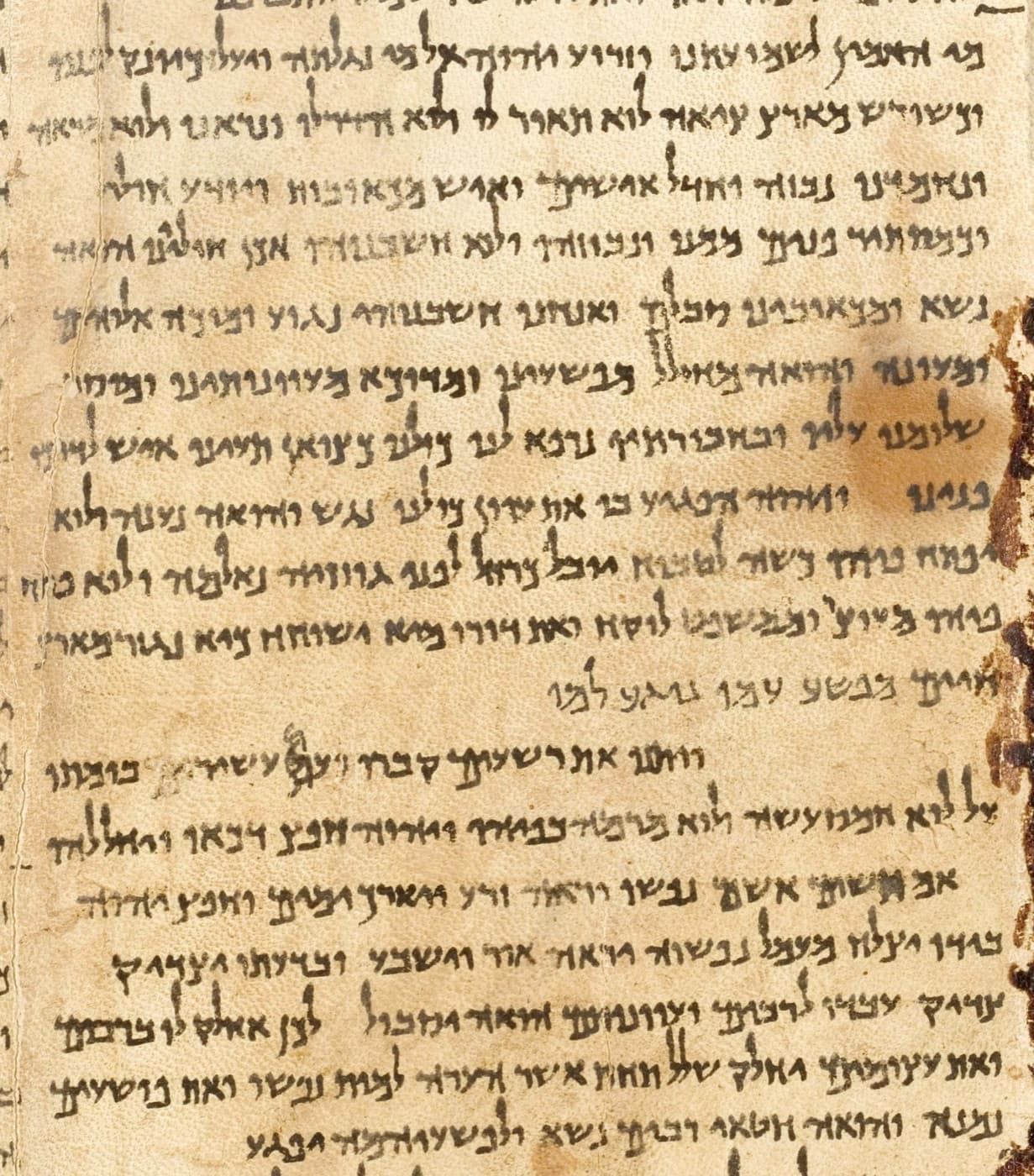
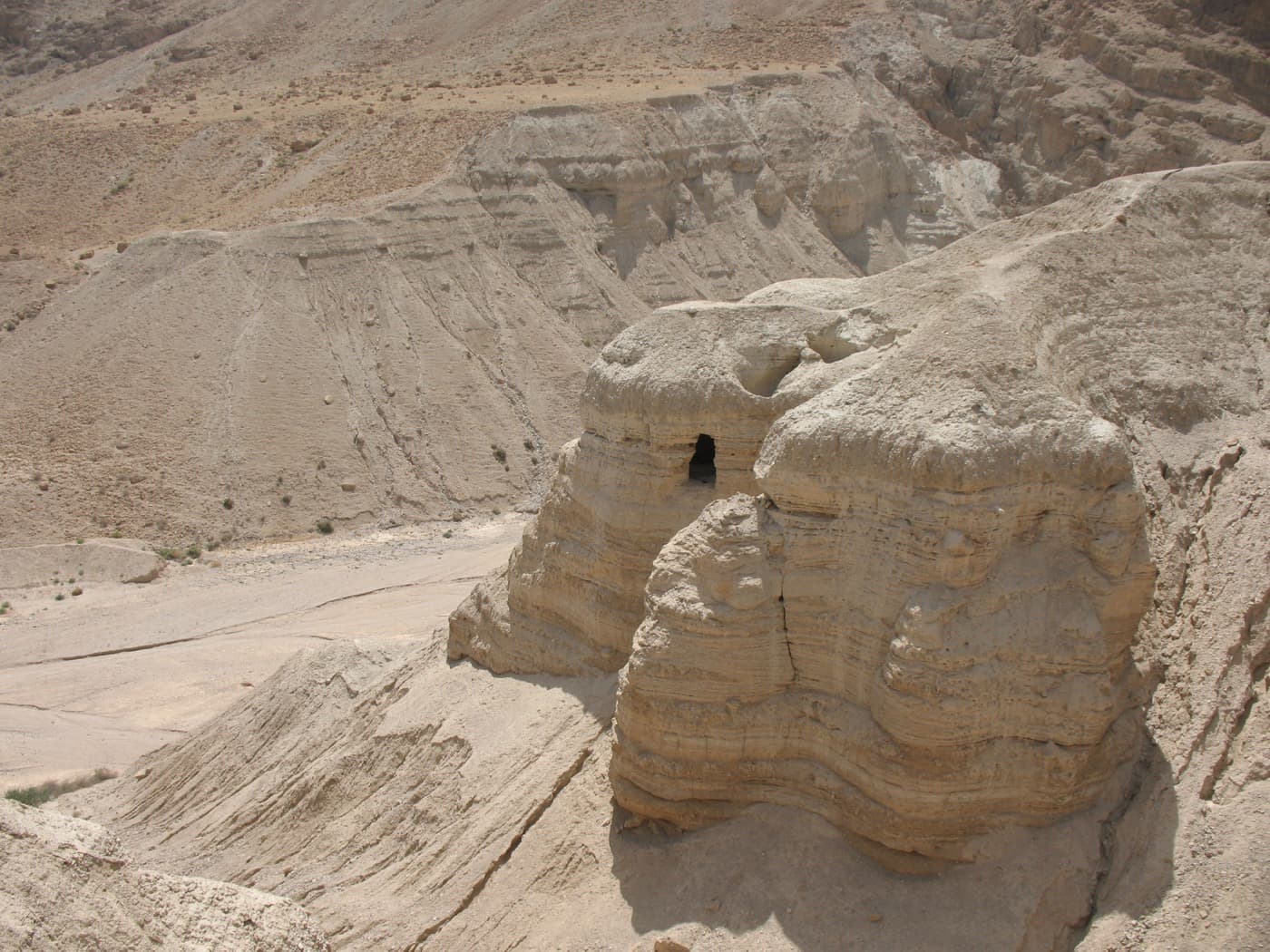
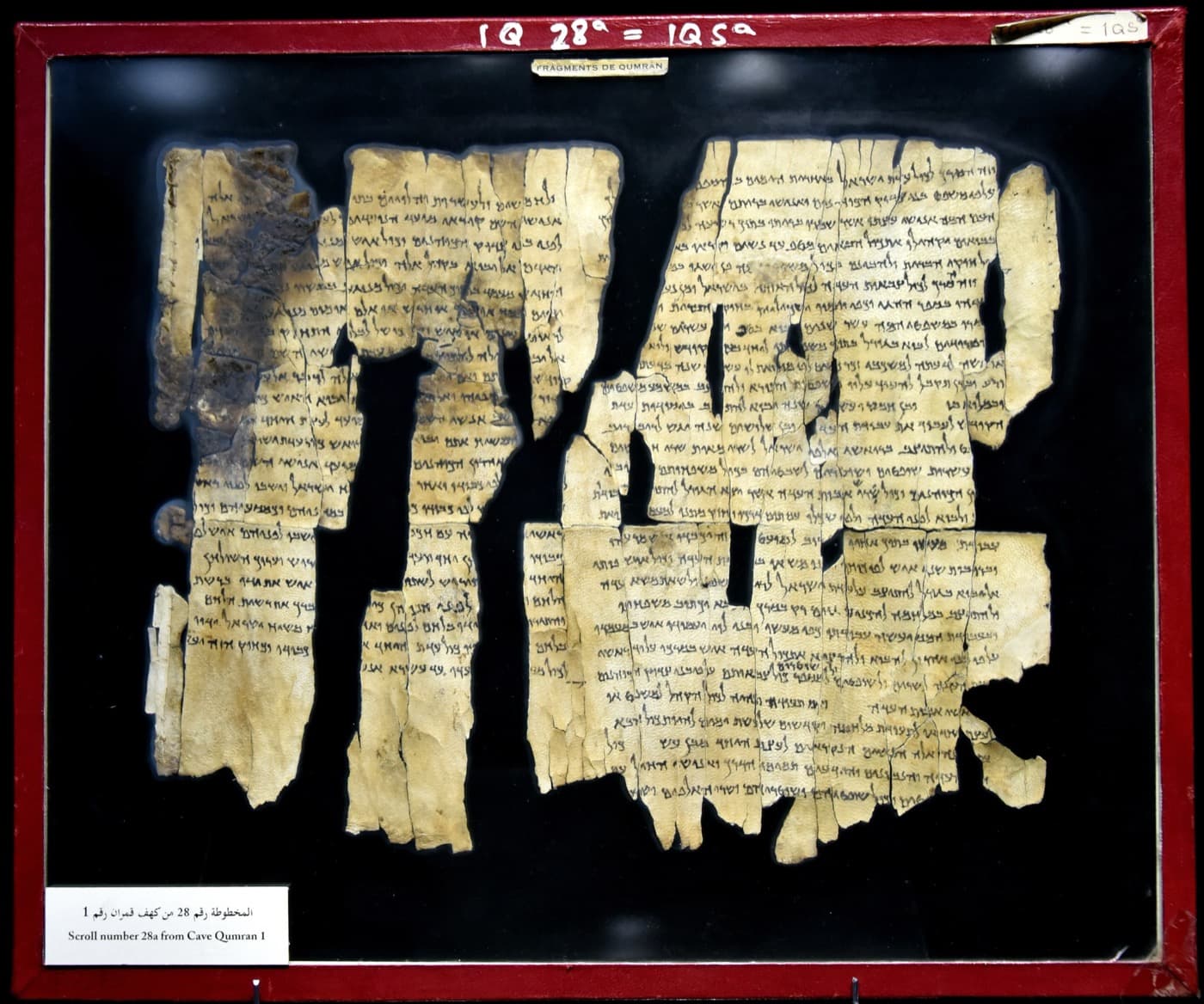
In 1947 a shepherd threw a stone into a cave above the Dead Sea and found a scroll of Isaiah a thousand years older than any Bible then known. It matches today’s Bible almost word for word, and it was written before Jesus came to live among us, so the text was copied faithfully and the prophecies in it could not have been added later. It is one find among many. This site did not create any evidence. It collects what historians and archaeologists have already found and lays it out, one place and one date at a time, so you can check it yourself.
Found in a cave at Qumran in 1947 by a Bedouin shepherd. Israel Museum, Jerusalem.
Why this site exists
If you are not a Christian
We want to show you, with evidence you can check for yourself, that the Bible is the true word of God, and that Jesus is who He said He was, so that you can put your trust in Him for your salvation.
If you are a Christian
We want to strengthen your confidence that what you believe rests on solid ground, so that you can trust the Bible and Jesus with even more assurance, and explain why to others.
5,800+
of the New Testament in its original Greek survive. The runner-up among ancient books has fewer than 2,000.
Explained in Section 04 · The evidence
~30 years
from the original to the oldest surviving copy of part of the New Testament. No original page of any ancient book survives, only copies. For Caesar or Plato, the oldest copy came 900 to 1,400 years after the author wrote.
Explained in Section 04 · The evidence
500+
people saw Jesus alive after His death, according to a statement Paul passed on that dates to within five years of the crucifixion.
Explained in Section 03 · The witnesses
1400 BC700 BC125 BC ▾AD 33AD 125AD 350Today
Qumran, Judean Desert · 125 BC
01What the Bible is
Summarized in one sentence
The Bible is a collection of real historical documents, written by real people, that God authored through them and has kept intact.
The Psalms Scroll · about AD 30–50
Found in Cave 11 at Qumran in 1956. Israel Antiquities Authority.
01
01What the Bible is7 min read
By the end of this section you will be able to explain why the Bible is a library of documents rather than one book, and why the church did not get to pick what went in it.
The Bible is a library of ancient documents about real people in real places.
It is not one book but sixty-six: histories, letters, poetry, law, biographies, and prophecy, written by about forty people over fifteen hundred years. They name kings, governors, cities, rivers, and battles. keeps digging those names up.
66
documents, 39 in the Old Testament and 27 in the New
~40
authors: kings, shepherds, a doctor, a tax collector, fishermen, a
3
languages: , , and , on three continents
1,500
years from the first book to the last
People and places from the Bible that archaeologists have dug up
For a long time some historians and critics said these people and places never existed and that the Bible made them up. Then found them.
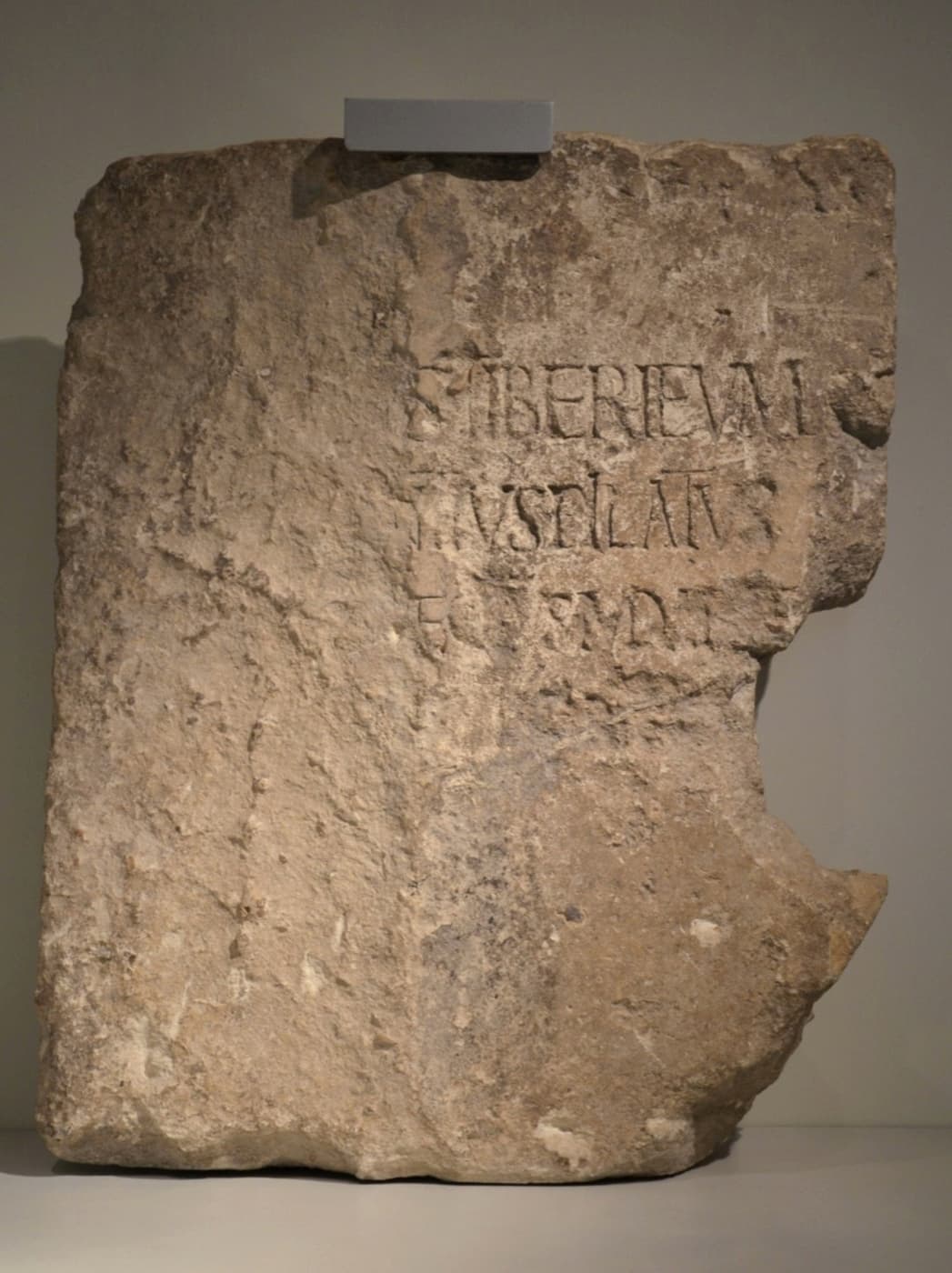
The Pilate Stone
AD 26–36 · Israel Museum, Jerusalem (a replica stands at Caesarea)
The only inscription from Pilate’s own lifetime that names him: “Pontius Pilate, of Judea,” dedicating a building to the . The Gospels give him exactly that title.
Found: In 1961 by an Italian team excavating the Roman theater at Caesarea Maritima, where the block had been reused as a step.
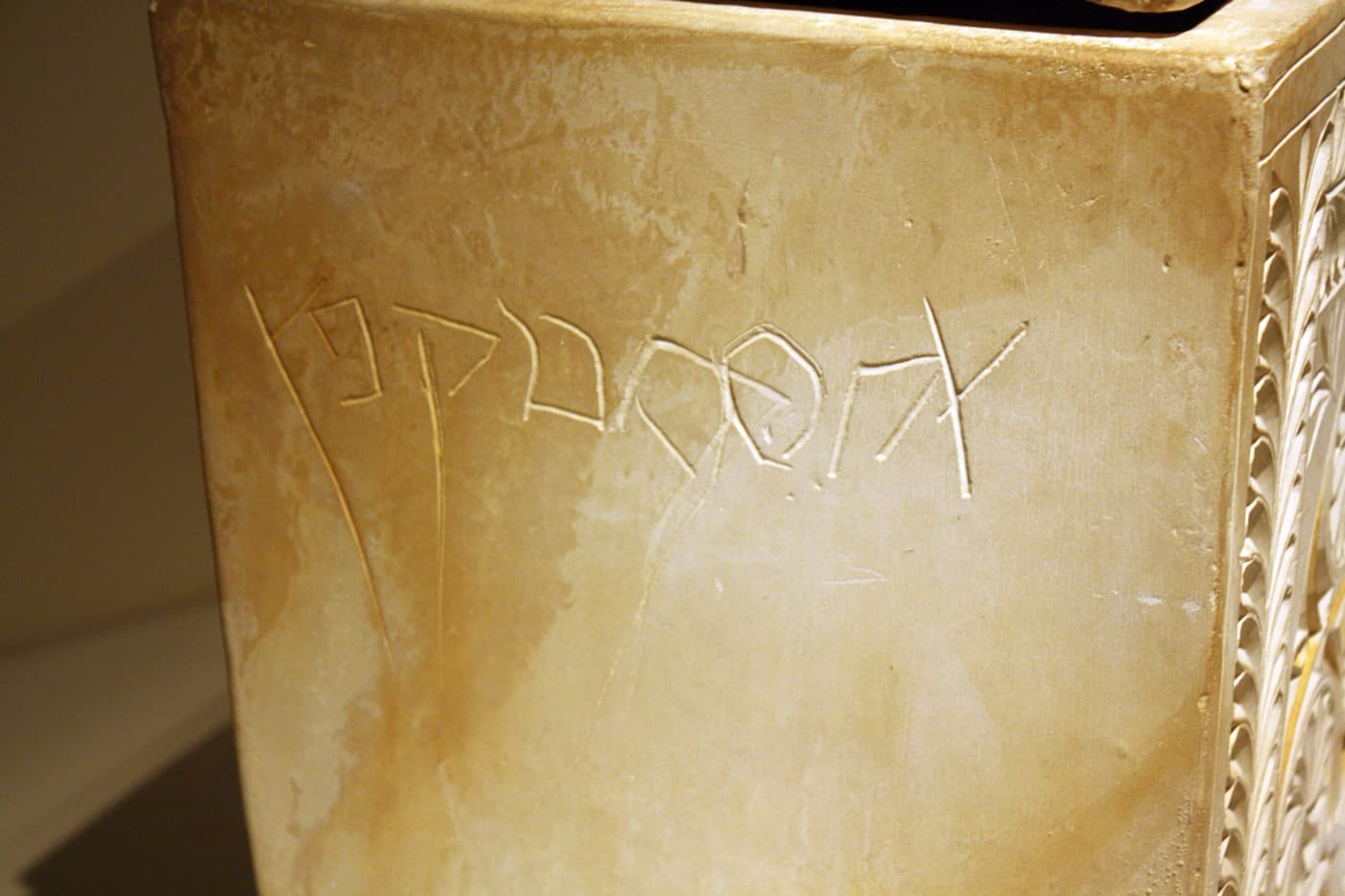
A bone box scratched with the name “Joseph son of Caiaphas.” gives the high priest who tried Jesus exactly that full name. Inside were the bones of a man of about sixty.
Found: In November 1990 when construction workers broke into a family tomb in the Peace Forest, south of Jerusalem’s Old City.
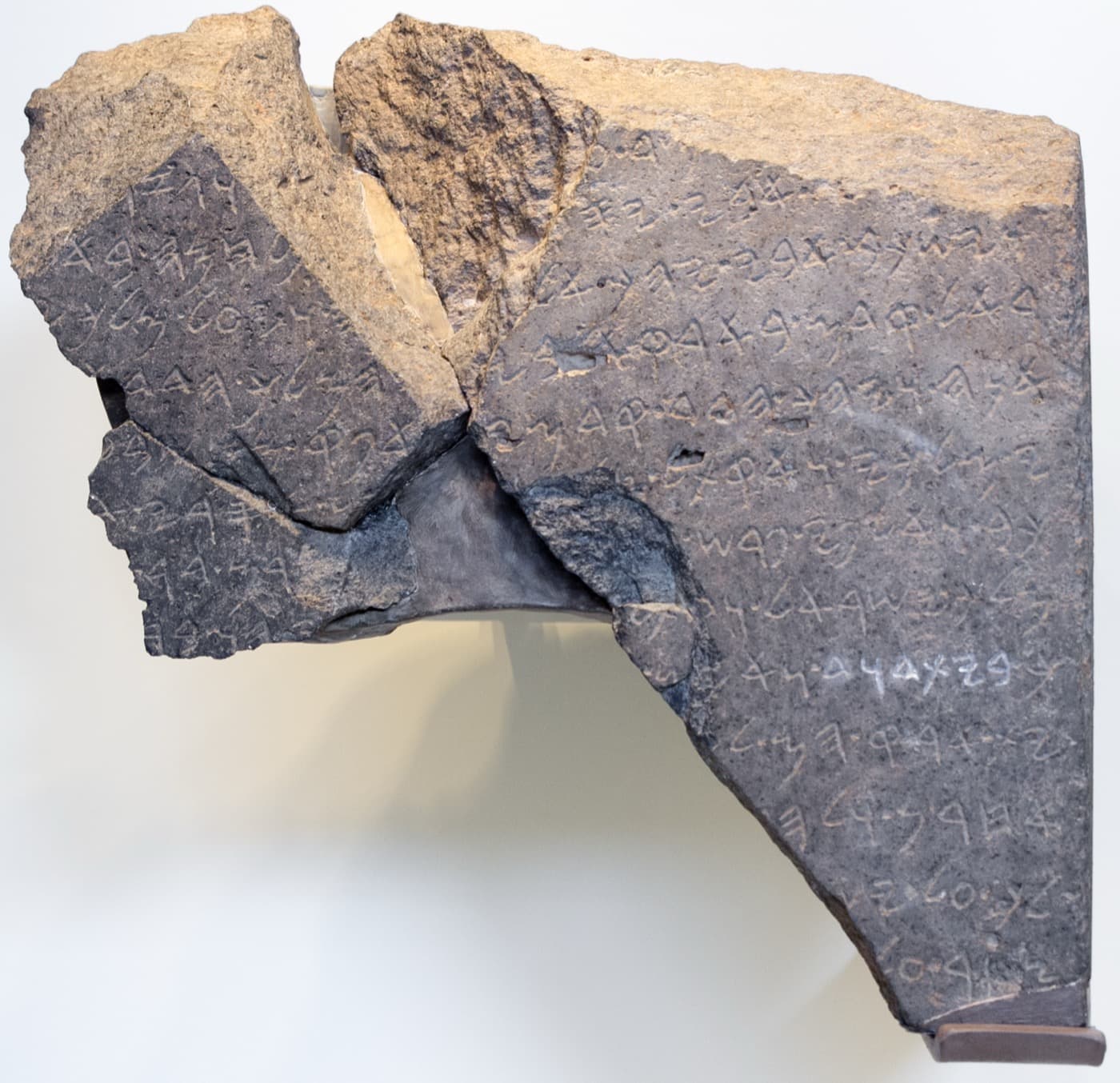
A victory monument set up by an enemy king of Aram, boasting that he killed a king of Israel and a king of “the House of David.” The first mention of David outside the Bible, about a century after his reign.
Found: In 1993, with two more pieces in 1994, by Avraham Biran’s excavation at Tel Dan in the far north of Israel, reused in a wall.
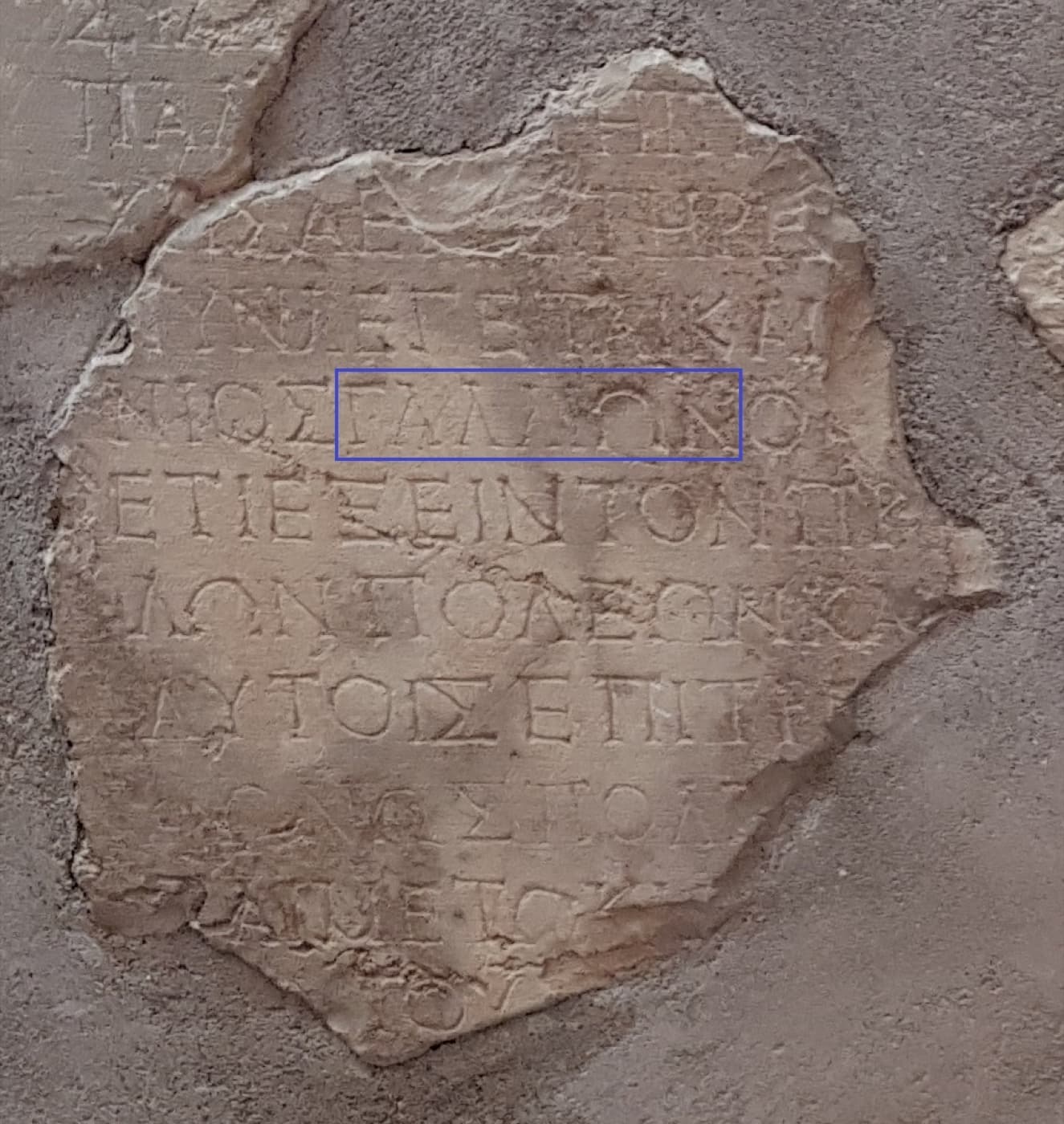
The Gallio inscription — the date that anchors Paul’s life
AD 52 · Delphi Archaeological Museum, Greece
A letter from the emperor Claudius carved in stone, naming Gallio as governor of (his name is boxed). Acts 18 says Paul stood before Gallio in Corinth. This stone pins that to AD 51–52, and with it the dates of Paul’s letters.
Found: In fragments at Delphi by French excavators in 1905 and 1910.
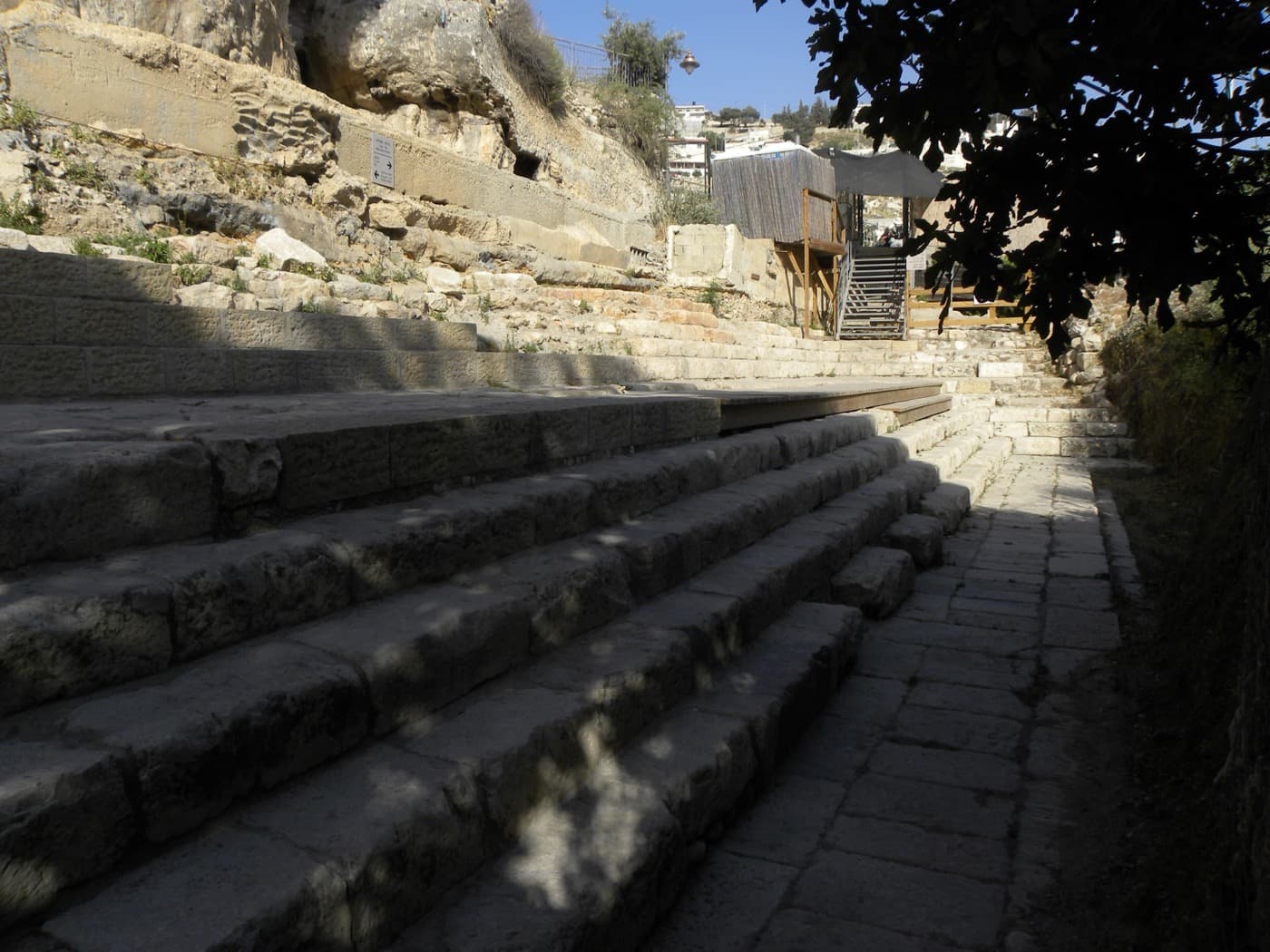
first century BC to AD 70 · City of David, Jerusalem
The stepped edge of the pool John describes in chapter 9, where Jesus sent a man born blind to wash and he came back seeing. The steps run down to a pool the size of a football field.
Found: In 2004 when a city crew repairing a sewer pipe south of the Temple Mount broke into the steps; excavated by Ronny Reich and Eli Shukron.
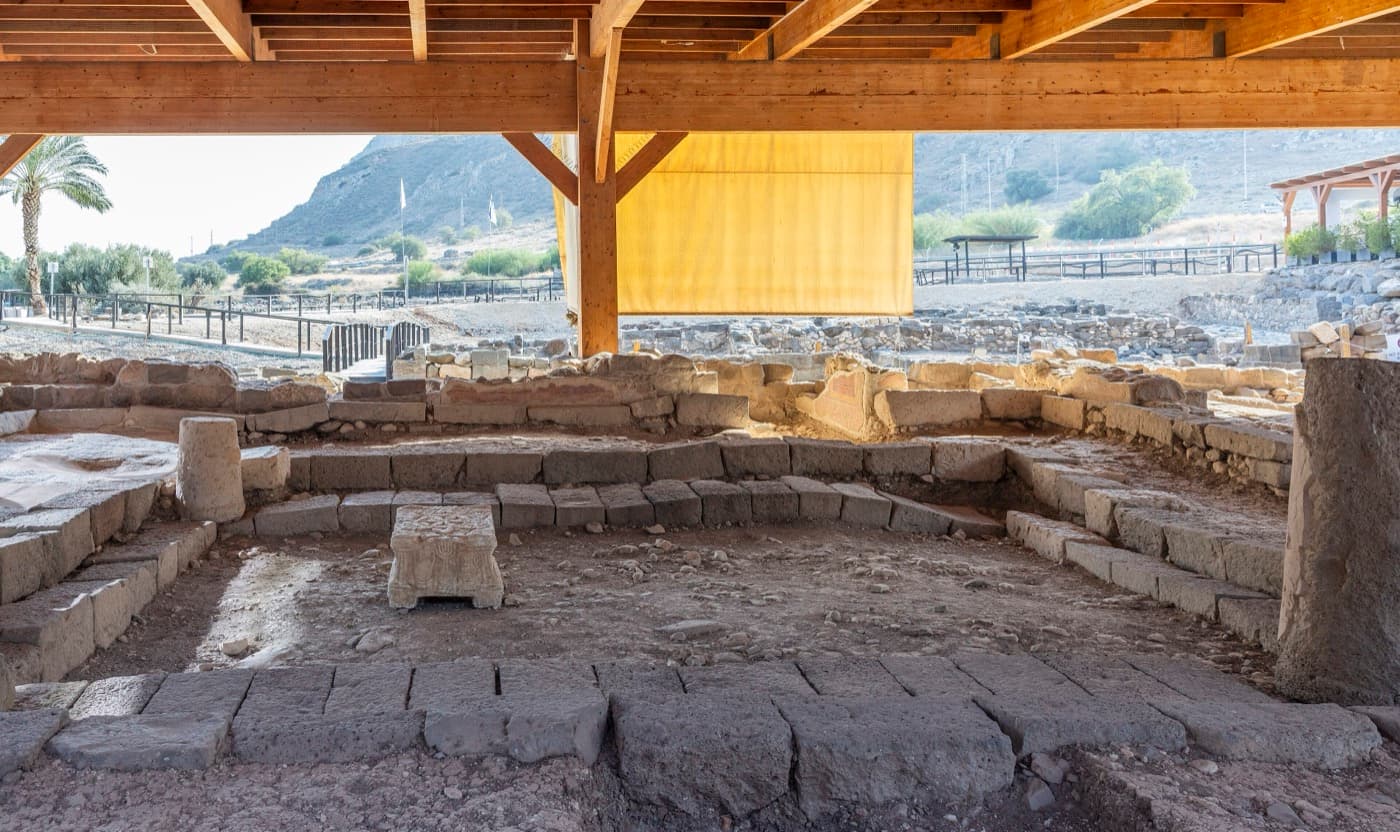
The Magdala synagogue — a synagogue Jesus almost certainly taught in
first century AD · Magdala, on the Sea of Galilee
One of the few from Jesus’ lifetime ever found, in the hometown of Mary Magdalene, a short walk from Capernaum. The Gospels say He taught in the synagogues throughout Galilee. The carved stone in the middle is the oldest known picture of the Temple’s menorah.
Found: In 2009 by Israel Antiquities Authority archaeologists checking the ground before a hotel was built on it.
A stone block carved on his orders with his name and title, “Pontius Pilate, of Judea,” dedicating a building to the . Found in 1961 at Caesarea, reused as a theater step. The only inscription from his lifetime that names him.
Caiaphas the high priest
His family tomb and bone box, found in Jerusalem in 1990.
The Pool of Siloam
Uncovered in 2004, exactly where John places the healing of the blind man.
The Pool of Bethesda
Once dismissed as fiction. Excavated, with its five colonnades, just as John describes.
The Ketef Hinnom silver scrolls
Two tiny rolled-up silver strips found in a Jerusalem tomb in 1979, engraved with the priestly blessing from Numbers 6. Dated to about 600 BC, they are the oldest known words from the Bible found anywhere.
The House of David
The Tel Dan , found in 1993, names David’s dynasty a century after his reign.
Gallio, governor of Achaia
An at Delphi dates his term to AD 51–52, pinning Paul’s visit to Corinth to the year.
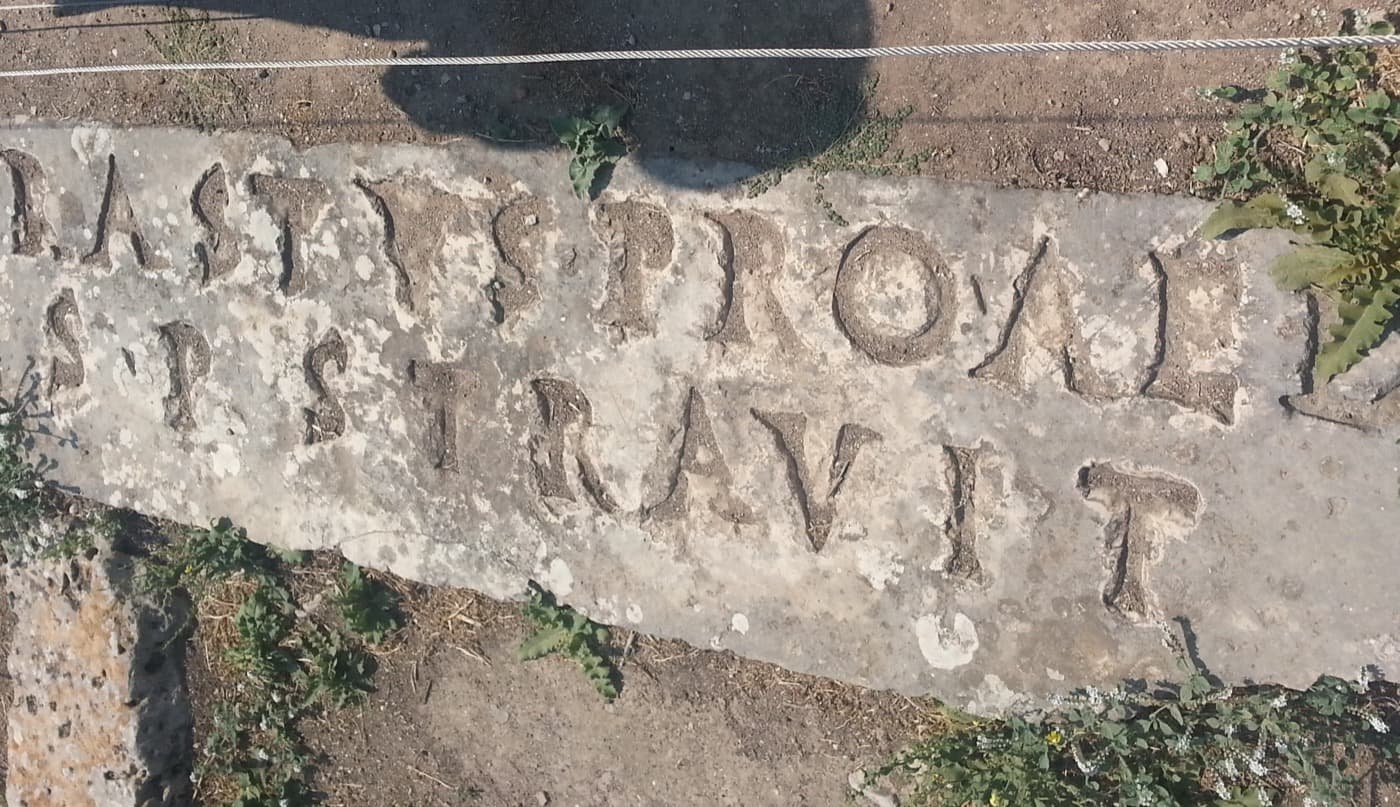
Erastus, city treasurer
A paving stone in Corinth records an who paid for it out of his own pocket.
The “politarchs” of Thessalonica
Luke uses a title for city officials found nowhere else in literature. Inscriptions in Thessalonica use exactly that word.
01
Luke did research. Paul wrote letters to friends. David wrote songs after bad nights. So how can any of it be the word of God?
Key point 01
God wrote it. He used people to do it.
The Bible says plainly how it came to be: real people wrote, in their own words and styles, and God’s Spirit carried them so that what they wrote is what He wanted said. Luke did research. Paul wrote letters to friends. David wrote songs after bad nights. None of that is in tension with God being the author. He is sovereign over the writer the way He is sovereign over the weather, and He does not need to override a person to work through them.
men spoke from God as they were carried along by the
all is breathed out by God
God spoke by the , and then by His Son
Luke describes his own research
“I have put my words in your mouth”
The same way He runs everything else
God working through human choices is not a special case for the Bible. It is how the Bible says He runs history. He turns the hearts of kings, sets the times and places of nations, and works all things according to His plan, without anyone being a puppet.
Who decided which books belong in the Bible, and when?
Two fair questions, with a surprising answer: there was never a single moment when someone decided. The list settled itself through use. Within a few decades of being written, the Gospels and letters were being read as God’s word in churches across the Roman world. By the AD 100s, the century right after the apostles, the core of the New Testament was the same everywhere. By AD 367 the full list of 27 was written out, and the councils that followed confirmed it. Here is the evidence, step by step.
The Old Testament was already a finished collection before Jesus came to live among us
By the first century, Jews had a settled set of . Jesus referred to it as “the Law, the Prophets, and the Psalms” and quoted from across it as the word of God. The Jewish historian wrote around AD 95 that the books were fixed and that no one had dared to add, remove, or alter anything. The , copied before Jesus, contain every Old Testament book except one.
Jesus spans the Hebrew Bible from its first book to its last
· Josephus, Against Apion 1.8
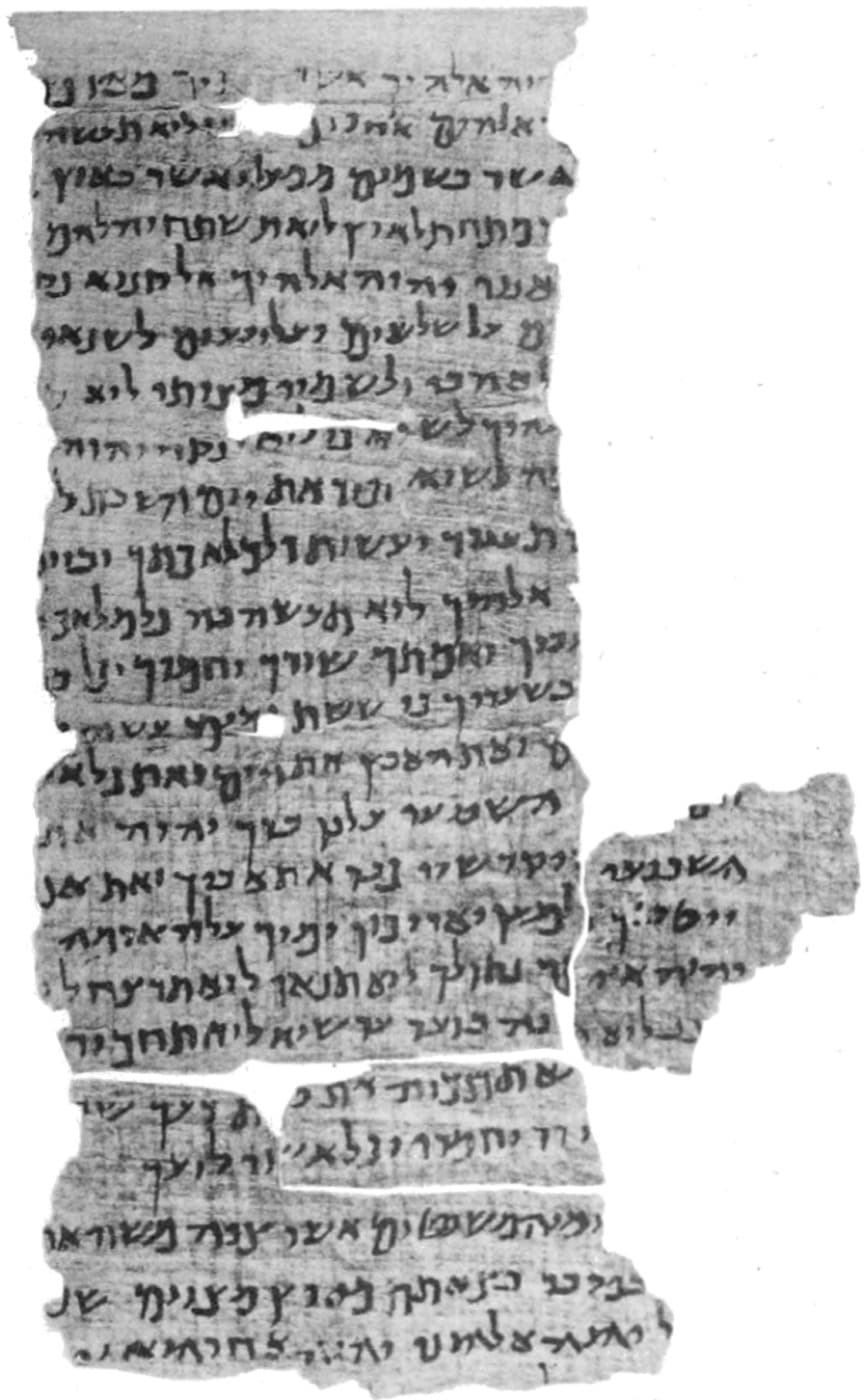
The Nash Papyrus — the Ten Commandments, before the Dead Sea Scrolls
about 150 BC · Cambridge University Library (MS Or. 233)
Twenty-four lines of : the Ten Commandments followed by the Shema, “Hear, O Israel.” Until 1947 this was the oldest known piece of the Hebrew Bible anywhere, a thousand years older than the next oldest copy.
Found: Bought in Egypt in 1902 by the English collector W. L. Nash and published in 1903; its date was fixed by the shape of the letters, the same method later used on the Dead Sea Scrolls.
Written by an , or by an apostle’s close companion
Matthew, John, Peter, and Paul were apostles. Mark wrote down Peter’s account. Luke traveled with Paul. James and Jude were the brothers of Jesus. A book with no link to the eyewitnesses did not qualify, however good it sounded.
2
Consistent with what was already known to be true
A book that contradicted the teaching handed down from Jesus and the apostles was rejected, no matter whose name was on it. The later “gospels” of Thomas, Peter, and Judas failed here, and they were also written a hundred years or more too late.
3
Used by the churches everywhere, from the beginning
The genuine books were read aloud in worship across the Roman world from the first century. Forgeries never had that history and never got in.
4
Carried the fingerprint of God
Christians recognized the voice of the Shepherd in these books, the way sheep know a voice. The lists did not give the books their authority. The books already had it.
When it came together, step by step
AD 48–95The 27 books are written, by apostles or people in their circle, all within living memory of Jesus.
AD 60sThe New Testament already calls itself : Peter puts Paul’s letters alongside “the other Scriptures,” and Paul quotes Luke’s Gospel as Scripture.
AD 95–110The next generation of leaders (, , ) quotes the Gospels and letters constantly, treating them as authoritative. Polycarp, according to his student , had known the apostle John.
about AD 150 describes Sunday worship: “the ,” meaning the Gospels, are read aloud alongside the prophets.
about AD 180Irenaeus names the four Gospels, “no more and no fewer,” and quotes almost every New Testament book. The , a list from about the same time, includes 22 of the 27.
AD 367 of Alexandria writes out the first surviving list with exactly our 27 books, and says he is recording what has been handed down, not deciding anything new.
AD 393–397Church councils at confirm the same 27. They were not choosing books. They were closing the door on adding any.
Around twenty of the twenty-seven books were never in doubt anywhere. The handful that took longer to be confirmed in every region (Hebrews, James, 2 Peter, 2 and 3 John, Jude, Revelation) were short letters whose authorship some distant churches wanted to verify. None of them was ever rejected for what it taught, and no core Christian belief rests on any one of them alone.
The New Testament already calling itself Scripture
The words were settled long before the binding was. For the first three hundred years, no Christian owned “a Bible” the way you can today, because no such object existed yet. Here is what they actually had, and how it became the single volume on your shelf.
Before Jesus
Scrolls, one book at a time
The Old Testament lived on scrolls, usually one book per scroll. The Great Isaiah Scroll is 24 feet long. A synagogue kept a set of them in a chest. Nobody could carry the whole Old Testament under one arm.
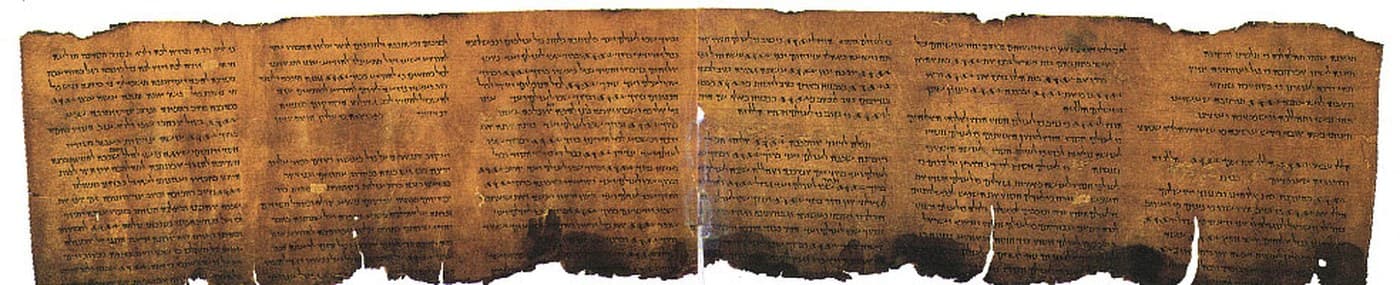
The Great Isaiah Scroll — one book, one scroll, 24 feet long
about 125 BC · Israel Museum, Jerusalem (Shrine of the Book)
Part of the scroll’s full length: seventeen sheets of leather stitched end to end, fifty-four columns of , all sixty-six chapters of Isaiah. Unrolled it runs about 24 feet (7.3 m). This is what “a book” looked like before the .
Found: In 1947 in Cave 1 at Qumran by a shepherd, in a clay jar; bought for Israel in 1954.
The New Testament arrived one piece at a time: a letter to a church, a Gospel written for a region. Churches copied them and sent them on to each other. Most people could not read, and books were expensive, so the Scriptures were read aloud when the church met. That is why Paul says, “have this letter read to all the brothers.”
AD 100–200
Christians switch from scrolls to the codex
A is a book with pages bound along one edge, the format you are holding when you hold a book. The Roman world still used scrolls for literature. Christians adopted the codex almost immediately and almost exclusively, because it could hold several books at once and you could flip straight to a passage. Nearly every early Christian manuscript is a codex.
about AD 200–250
The first collections
The oldest surviving collections bind related books together: one codex with the four Gospels and , another with Paul’s letters. These were the New Testament in sections, made for churches to read from.
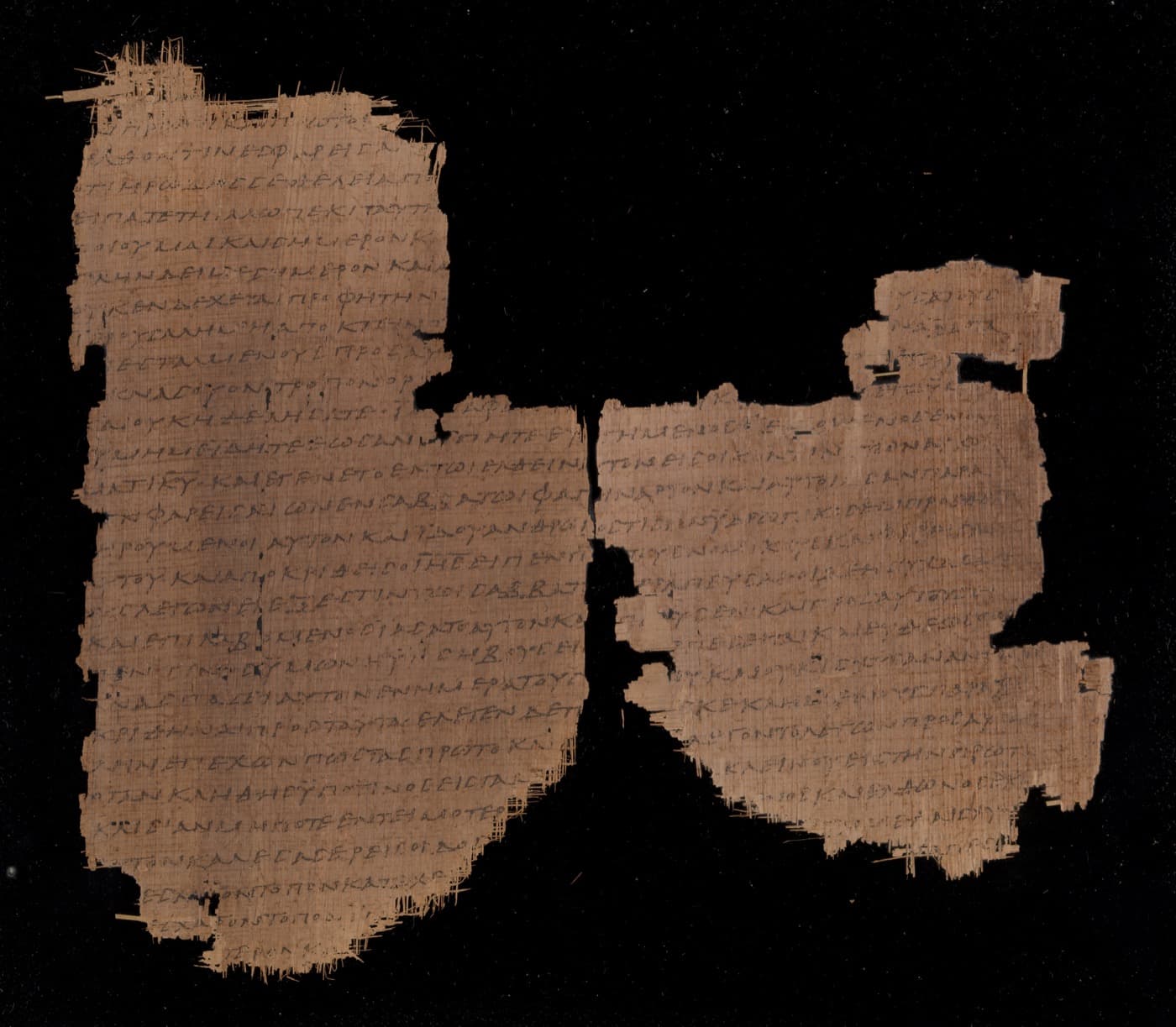
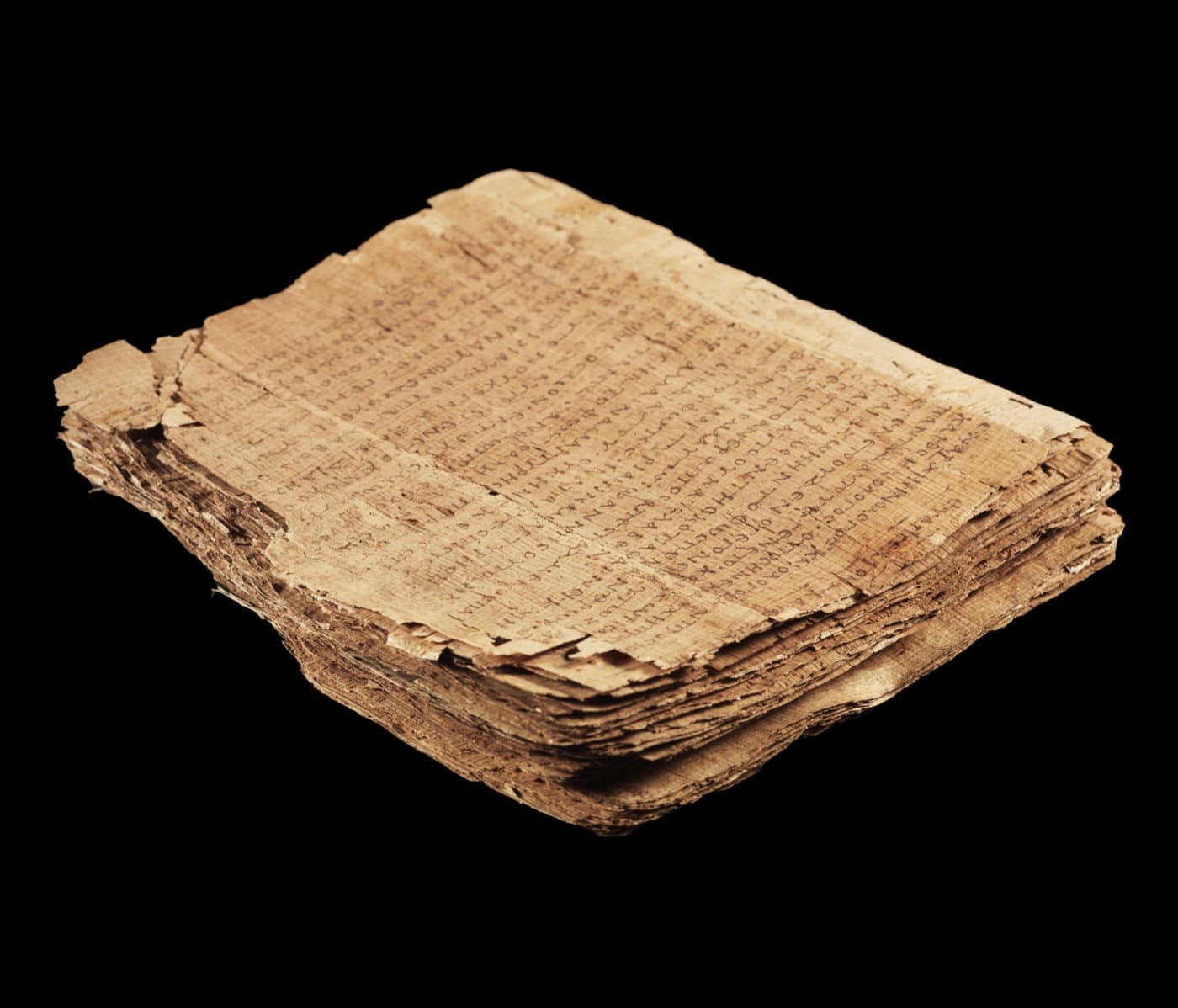
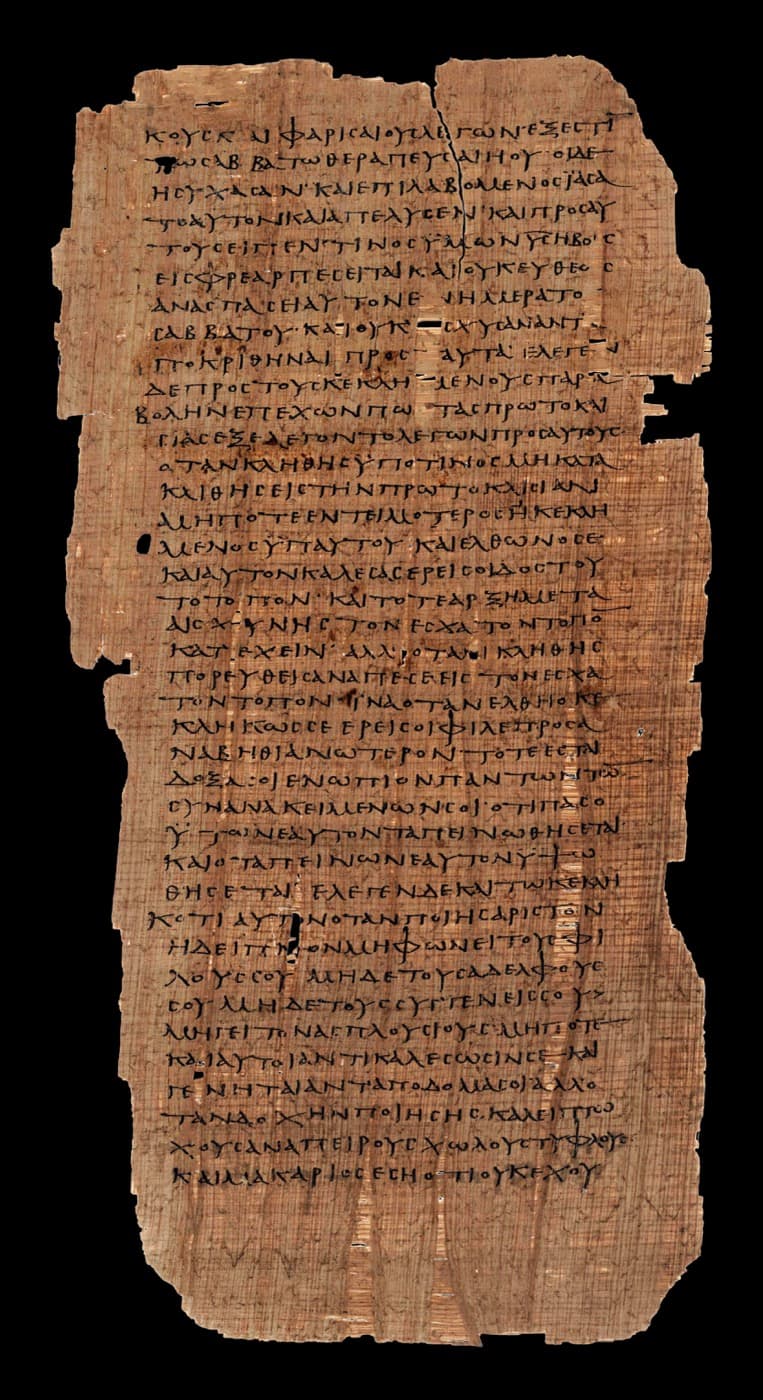
Papyrus 45 — the four Gospels and Acts together
about AD 200–250 · Chester Beatty Library, Dublin
The oldest surviving codex that bound the four Gospels and as one book. This leaf carries Luke 13:29 to 14:10.
Found: Surfaced in Egypt with Papyrus 46 and bought by Alfred Chester Beatty in 1930–31.
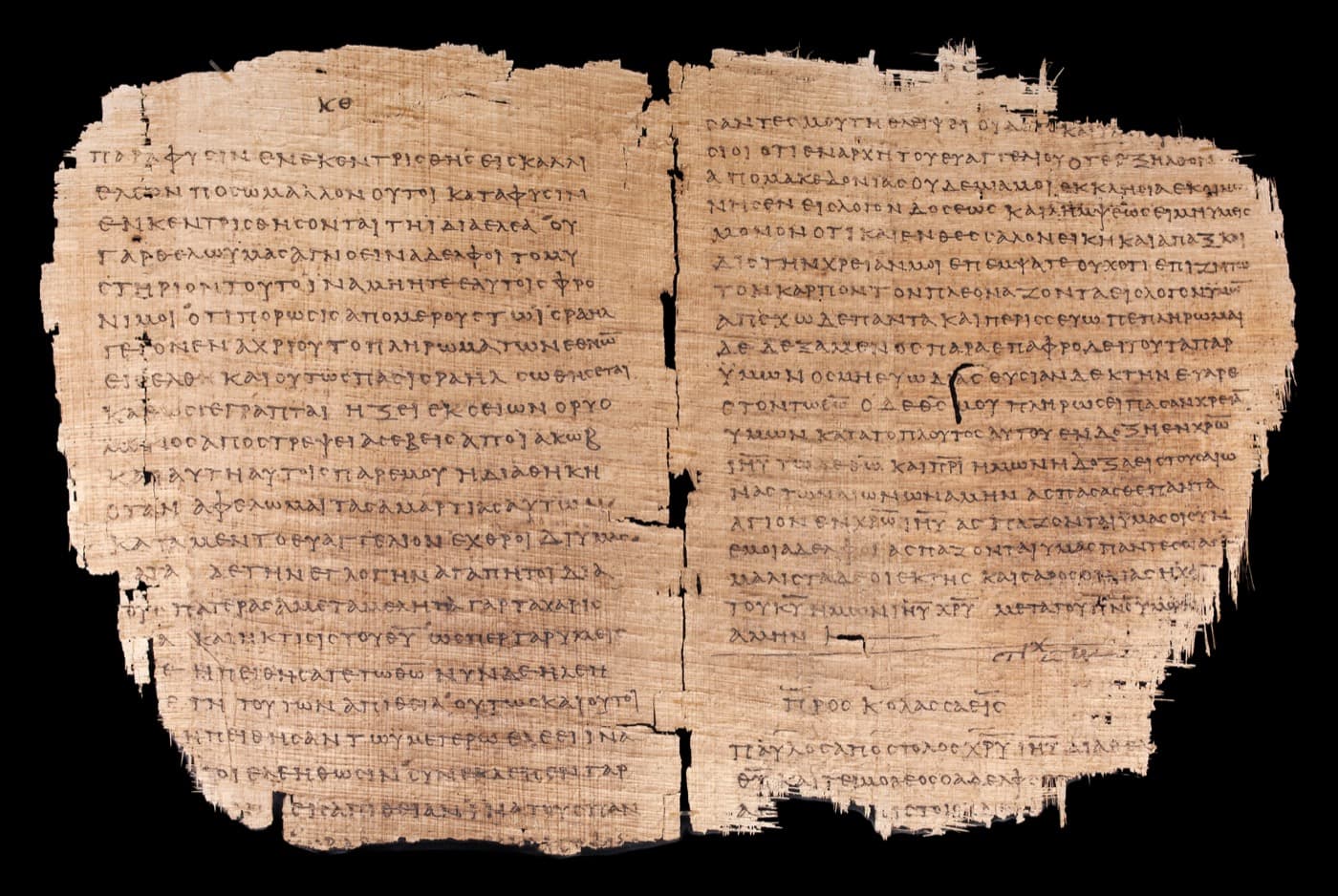
about AD 200 · Chester Beatty Library, Dublin (with leaves at the University of Michigan)
The oldest surviving collection of Paul’s letters, bound as a single codex. This opening shows the last words of Philippians and the title “To the Colossians.”
Found: Surfaced in Egypt, probably near the Fayum, and bought by the collector Alfred Chester Beatty in 1930–31.
Codex Sinaiticus and Codex Vaticanus are the oldest surviving Bibles with Old and New Testament together in one set of bound volumes. Around AD 331 the emperor ordered fifty complete Bibles for the churches of his new capital, so by then a whole Bible was something you could commission. Both are written in Greek. For the New Testament that is the original language. For the Old Testament it is the , the Greek translation Jewish scholars had made two or three centuries before Jesus, and the version the apostles usually quoted. The Hebrew Old Testament kept being copied separately, on scrolls, by Jewish .
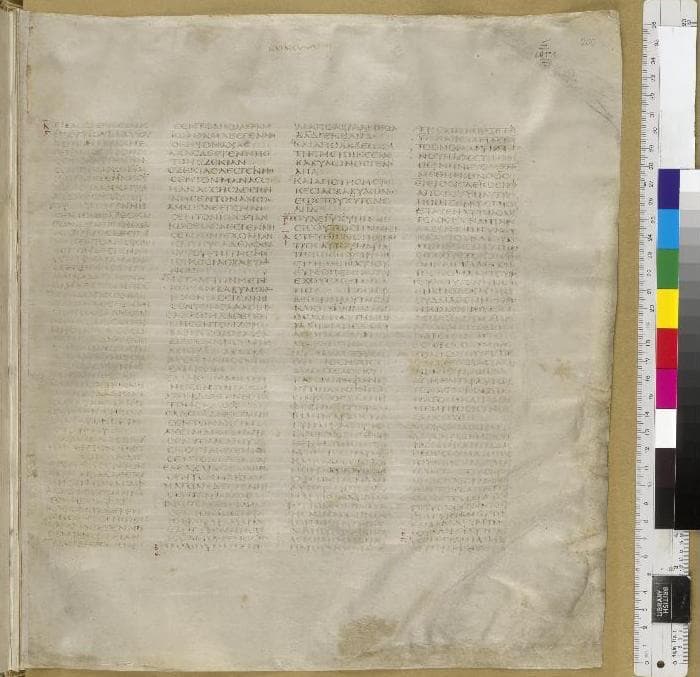
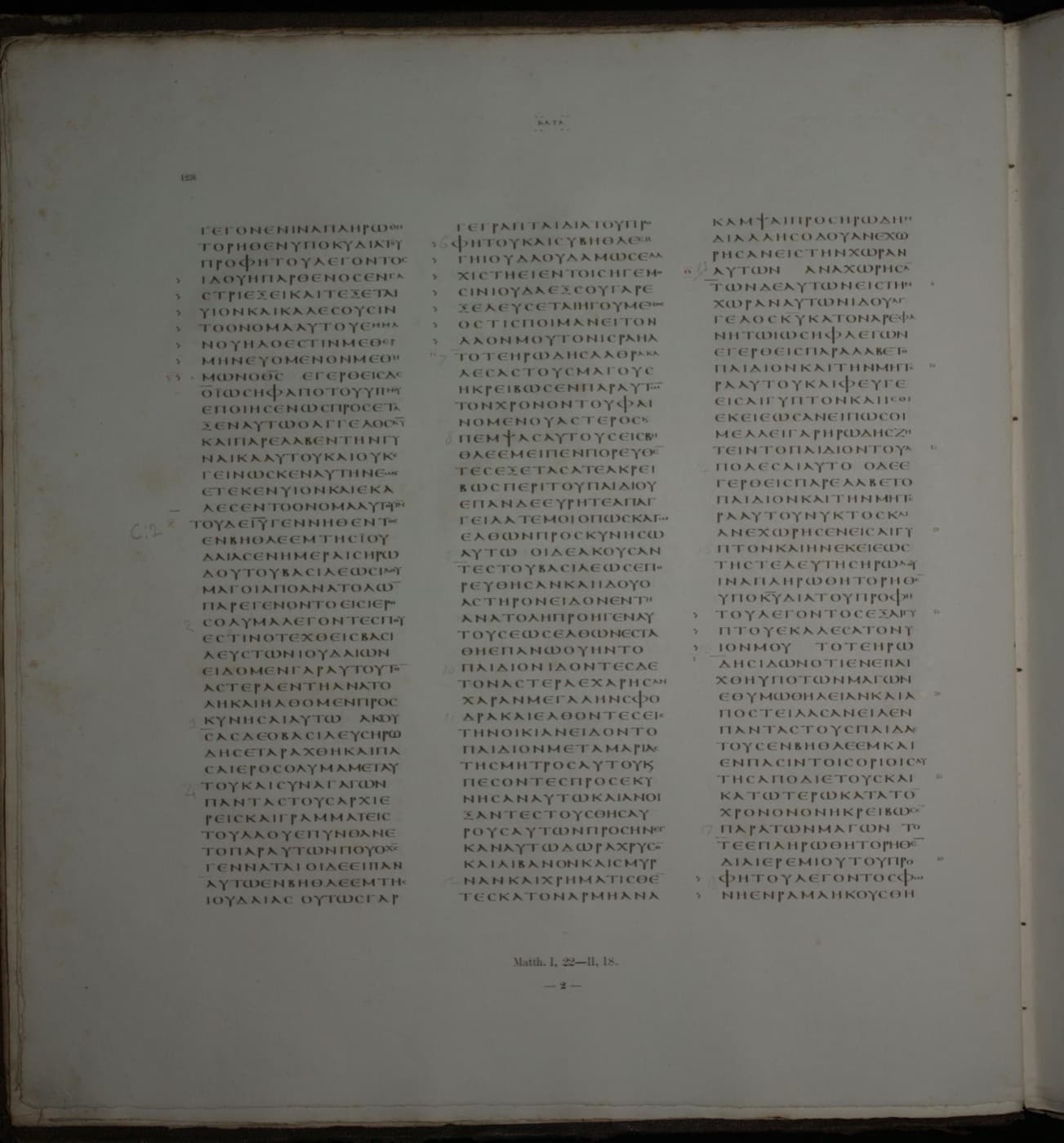
Codex Sinaiticus — the first page of Matthew
about AD 350 · British Library, London
One of the two oldest complete Bibles in existence, written on about 300 years after the events. It is in , the language the New Testament was written in. The full codex has been digitized and can be read online.
Found: By the German scholar Constantin von Tischendorf at St Catherine’s Monastery on Mount Sinai, a few leaves in 1844 and the bulk in 1859; most of it has been in London since 1933.
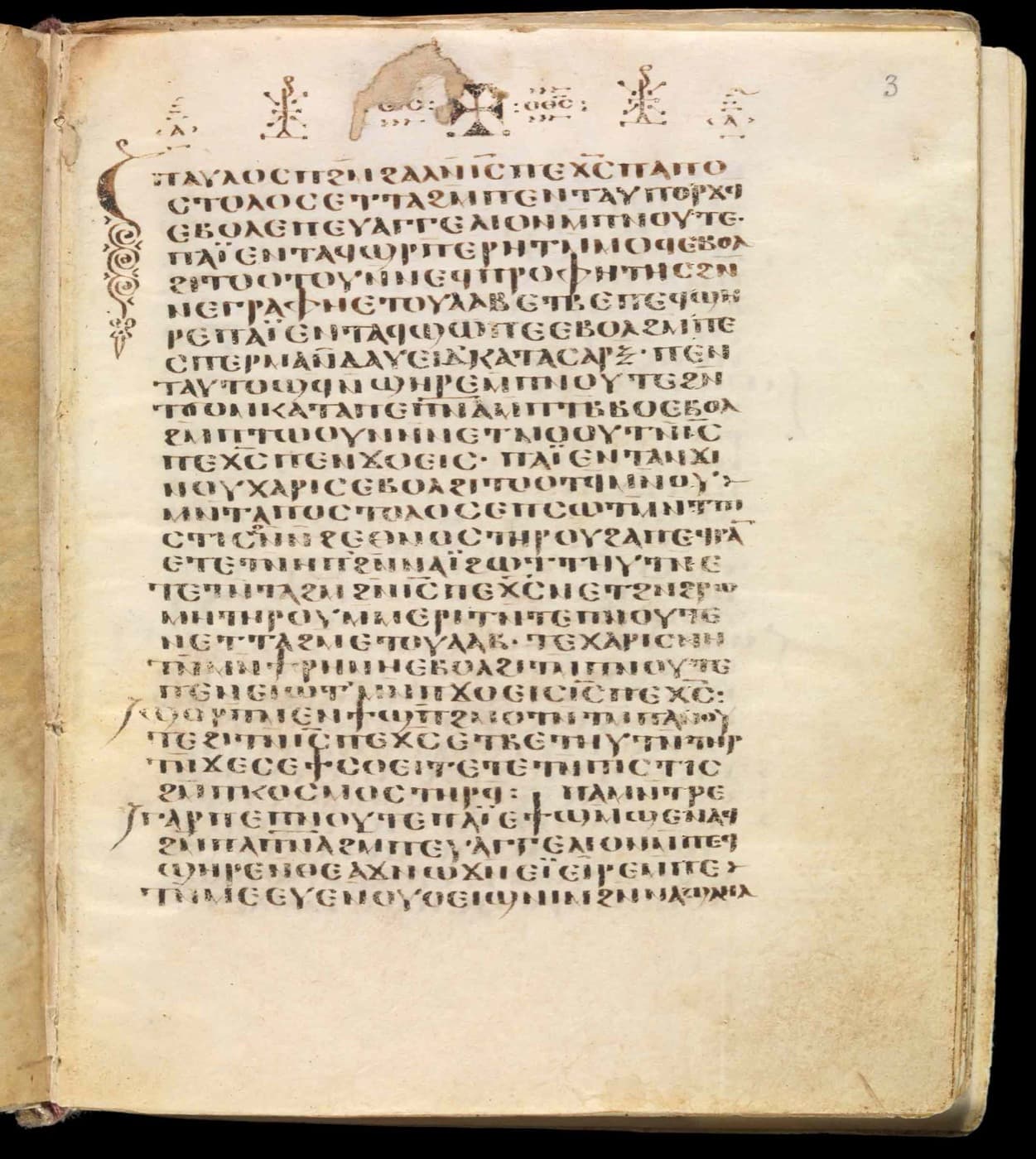
The other oldest complete Bible, and probably a little older than Sinaiticus. Three narrow columns of Greek capitals with no spaces between the words, the normal way of writing at the time.
Found: Listed in the Vatican Library’s first catalog in 1475. Where it spent its first eleven centuries is unknown; Egypt or Caesarea are the usual guesses.
A full Bible on needed the skins of a few hundred animals and months of a trained copyist’s time. And for most of those three centuries Christianity had no legal protection and was periodically persecuted; in AD 303 the emperor ordered all Christian Scriptures burned. Only after Christianity was legalized in AD 313 could whole Bibles be produced openly. The content was fixed by use long before; the packaging waited for safety and money.
1227 and 1551
Chapters and verses
The chapter divisions were added by , an English archbishop, around 1227. The verse numbers came from a Paris printer, , in 1551. They are a finding aid, not part of the original text, which is why a chapter sometimes breaks in an awkward place.
1455 onward
Printing puts a Bible in every home
The first major book printed with movable type in Europe was a Bible, in , in 1455. Translations into everyday languages followed, ’s English New Testament in 1526 among them, and for the first time an ordinary person could own the whole Bible and read it at home.
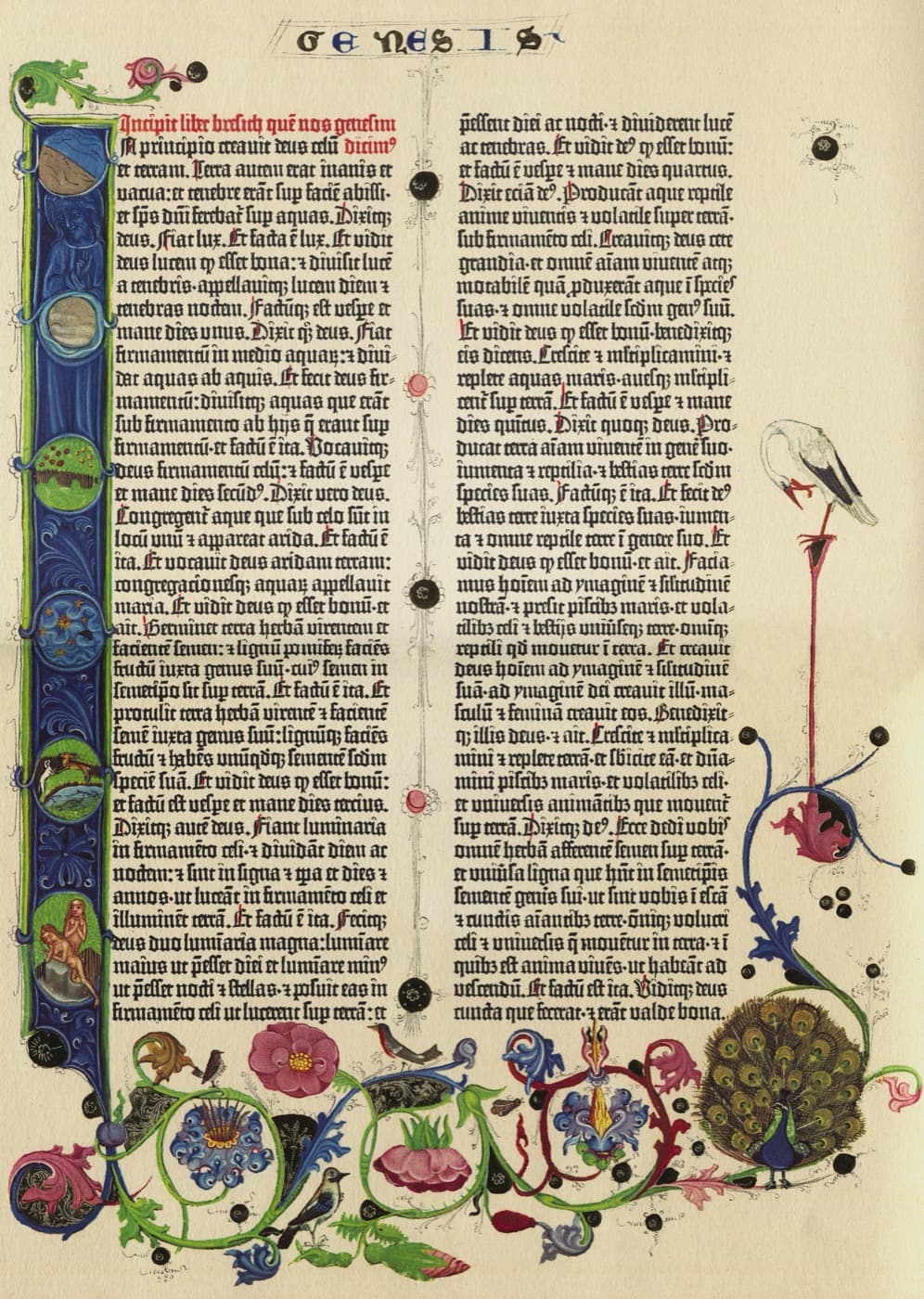
The Gutenberg Bible — the first book printed in Europe
about 1455 · Berlin State Library (one of about 49 surviving copies)
The opening of Genesis in . The type was printed in Mainz by Johannes Gutenberg; the vines and animals were painted in by hand afterward, copy by copy. Before this, every Bible in the world had been written out by hand.
Found: Never lost: about 180 were printed in Mainz around 1455, and 49 survive in libraries around the world. This illuminated copy has been in Berlin since the 1800s.
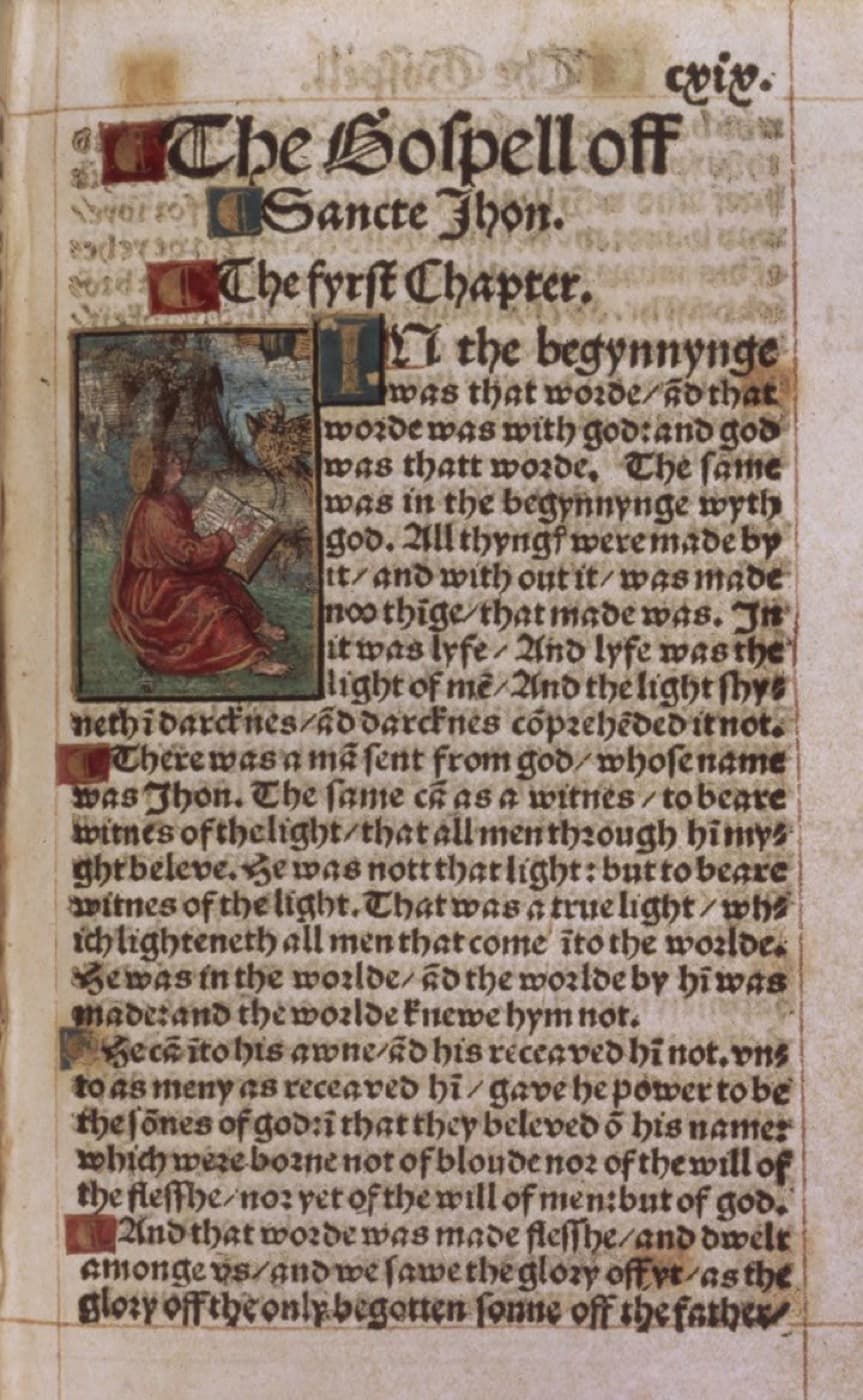
Tyndale’s New Testament — the first printed English Bible
1526 · British Library, London (one of three surviving copies)
“In the begynnynge was that worde.” The opening of John in ’s translation, printed in Worms and smuggled into England in bales of cloth. Owning one was a crime. Tyndale was strangled and burned for it ten years later; most of the King James Bible is still his wording.
Found: Never lost, but nearly: the church burned every copy it could find. Three survive; this one was bought by the British Library in 1994.
So the early Christians never had to wait for “the Bible” to be finished before they could trust it. They had the same words you have, read aloud to them, one book at a time. What changed over the centuries was the binding, not the message.
When was the New Testament written?
All of it was written within a single human lifetime. The last book was finished about sixty years after the , while the last , John, was still alive. Compare that with the biographies of most ancient figures, written centuries after their deaths. Dates below are the ones used in the ; scholars debate a few by a decade or so, and none of the debates move a book out of the first century.
AD 30
AD 40
AD 50
AD 60
AD 70
AD 80
AD 90
AD 100
AD 30Crucifixion and resurrectionAD 30 or 33
AD 35The creed Paul later quotesA short, memorized summary of the (Jesus died, was buried, rose, and appeared to named witnesses) that Paul was taught and later wrote down in 1 Corinthians 15:3–7. Dated to within about five years of the .
AD 48Galatians and Jamesthe earliest letters, about AD 48–50
AD 511 & 2 Thessaloniansabout AD 51, dated by the Gallio
AD 551 & 2 Corinthians, Romansabout AD 53–57
AD 62Ephesians, Philippians, Colossians, Philemonfrom prison, about AD 60–62
AD 62Luke and ActsActs ends in AD 62 with Paul still alive, so both were finished by then
AD 65Mark, Matthew, 1 & 2 Peter, Hebrewsabout AD 55–70
AD 70Jerusalem and its temple destroyed by RomeJesus had predicted this about forty years earlier, in detail. No mentions it as having already happened, one sign they were written before it.
AD 90John’s Gospel and lettersabout AD 85–95
AD 95Revelationabout AD 95, the last book
AD 100John, the last eyewitness, diesabout AD 100
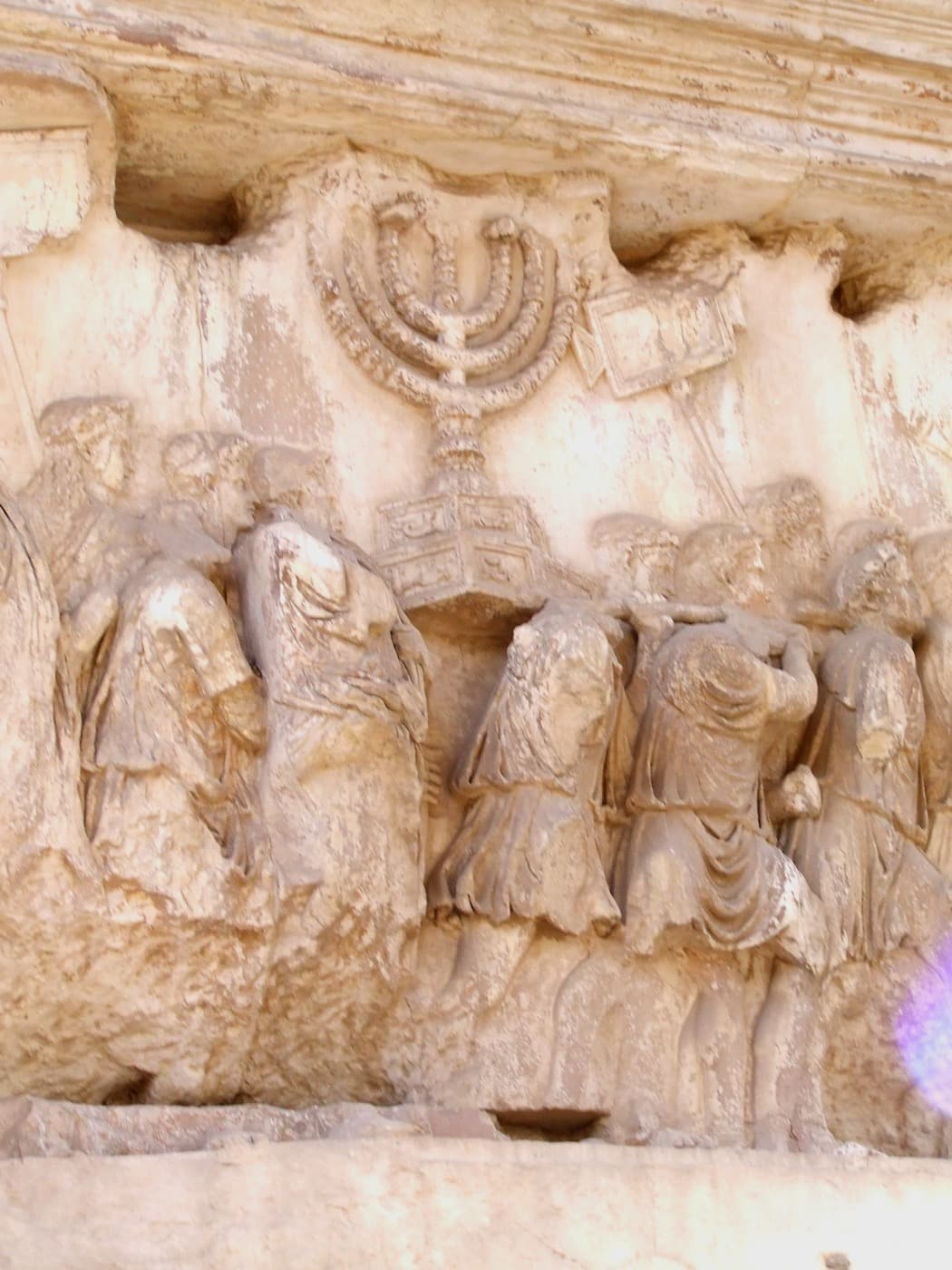
The Arch of Titus — Rome celebrates the fall of Jerusalem
AD 81 · Roman Forum, Rome
Roman soldiers carrying the ’s golden lampstand and trumpets through Rome in the victory parade of AD 71, carved into the arch built for the general who did it. Jesus had said, forty years earlier, that not one stone of the Temple would be left on another.
Found: Never lost: the arch has stood at the entrance to the Forum since AD 81. Restored in 1821.
Sixty-five years from the events to the last page. The John is the living example: a young man when Jesus was crucified, an old man when he wrote Revelation. The whole New Testament was in circulation while people who had known Jesus could still have objected to it. None did.
So the words are old, and they reached you intact. That only matters if what they say is true. What do they actually claim?
Next stop · The storySixty-six books, one storyline. What is it actually about, and why does it point to one person?↓
And He kept it safe.
God promised that His words would outlast the grass, the flowers, and the sky itself. Thousands of , a scroll in a desert cave a thousand years older than anyone expected, and a text that matches across centuries of copying: that is what the promise looks like when you can hold it.
1400 BC700 BC125 BCAD 33 ▾AD 125AD 350Today
Bethlehem to Jerusalem · about 5 BC to AD 33
02The story
Summarized in one sentence
The Old Testament promises a rescuer; the New Testament shows Jesus fulfilling that promise and claiming to be God Himself.
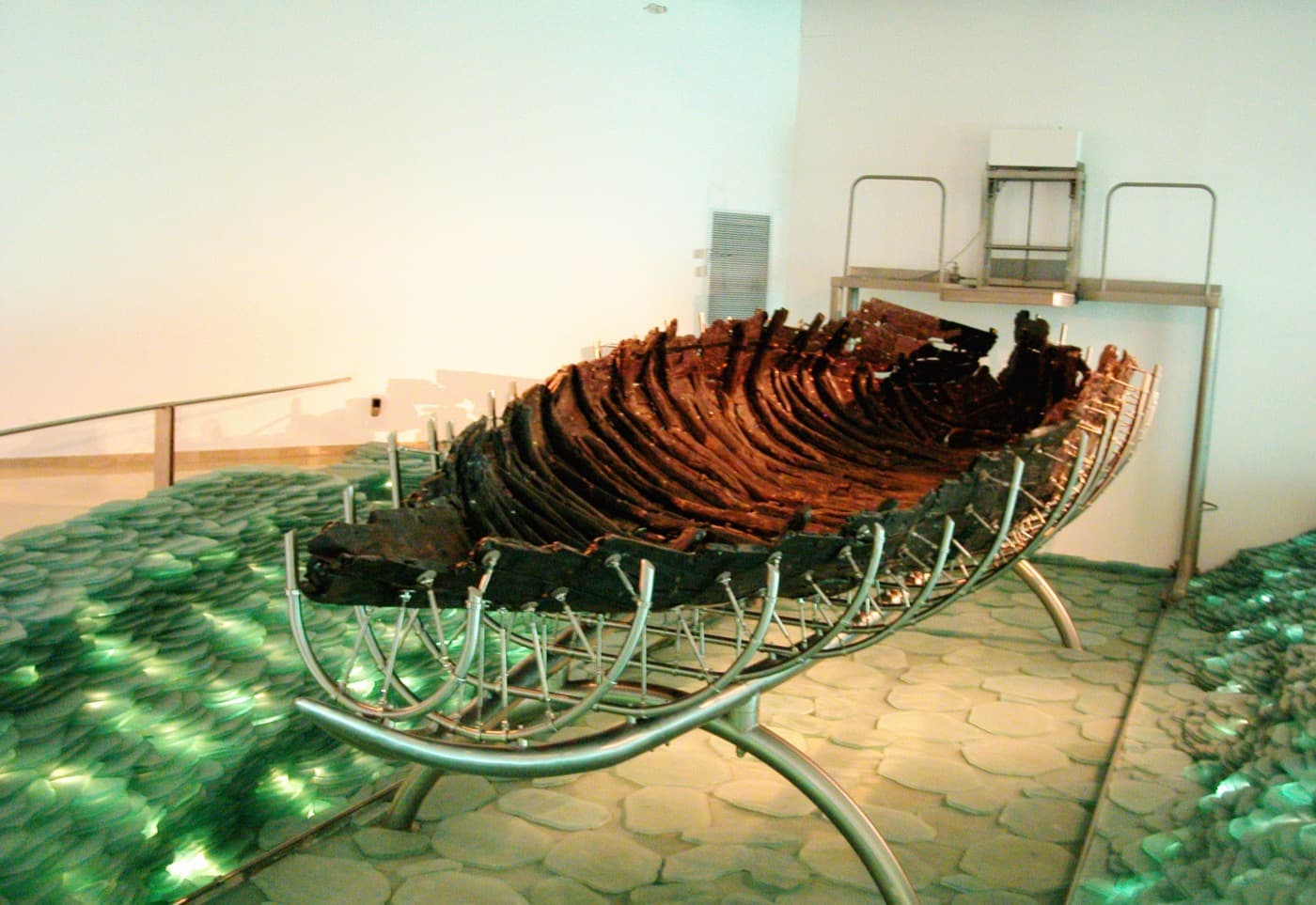
The Galilee boat · about 50 BC to AD 50
Found in the mud of the Sea of Galilee in 1986 during a drought. Yigal Allon Center, Ginosar.
02
02The story9 min read
By the end of this section you will be able to explain how the Old Testament described Jesus centuries early, and why “just a good teacher” is not an option He left open.
The Old Testament is God’s promise. The New Testament is that promise fulfilled.
Sixty-six books, written over fifteen centuries, tell one story. It has four beats. Once you see them, the whole Bible reads as a single line of thought.
01
God made everything, and it was good.
The Bible opens with a world that works: light, land, life, and people. Nothing broken, nothing missing. God looks at all of it and calls it very good.
02
He made us in His image, free to choose.
God did not make robots. He made people who reflect Him, and He gave them a real choice, including the choice to walk away. Love that cannot say no is not love.
one command, and the freedom to break it
“choose life”
03
We chose to walk away.
The first people disobeyed and hid from God. Every generation since has done the same in its own way. That break, not bad luck, is why the world is not the way it should be, and why none of us is as good as we know we should be.
“all we like sheep have gone astray”
04
God promised to fix it Himself.
Instead of leaving people to climb back on their own, God promised a rescuer. The rest of the Old Testament keeps narrowing down who He would be: a descendant of Abraham, from King David’s family, born in Bethlehem, a king who would suffer for other people’s sins and then reign forever.
the first promise, made the same day things broke
through Abraham, all nations blessed
a king from David’s line, forever
a child born, called Mighty God
wounded for our sins
born in Bethlehem
a new
01
The Sunday after the crucifixion, two of His followers walked about seven miles with a stranger. By the end of the road they were convinced the whole Bible was about the man beside them. What did He show them?
Key point 01
Jesus said the whole Old Testament was about Him.
After His He walked two followers through “Moses and all the Prophets” and showed them where He was in every part. The writers of the New Testament make the same claim on almost every page: this is the promise, kept.
“all the promises of God find their Yes in him”
What is a prophecy?
A specific statement about the future, made in God’s name and written down before it happened. The Bible sets its own test: if what a says does not come true, he did not speak for God. That is a test anyone can check. It is also why fulfilled prophecy matters so much. It is God signing His work in advance.
300+
How many prophecies did Jesus fulfill?
It depends on how you count. Scholars who list every Old Testament verse pointing to the arrive at anywhere from about 200 to over 400: Alfred Edersheim counted 456, J. Barton Payne, 574. A conservative count of clear, specific prophecies fulfilled in Jesus’ life is over 300. The nine in the list are among the most concrete, and each names a place, a price, a manner of death, or a family line that no one chooses for themselves.
These are not edits made after the fact. The Great Isaiah Scroll, found among the , was copied around 125 BC, more than a century before Jesus came to live among us, and it contains all of Isaiah 53.
Anyone can compare this column with a modern Bible. Isaiah 53 in the scroll and Isaiah 53 in the book on your shelf are the same chapter, and the scroll was in a cave near the Dead Sea before the first Christmas.
The Great Isaiah Scroll — Isaiah 53
about 125 BC · Israel Museum, Jerusalem (Shrine of the Book)
The column containing all of Isaiah 53, “he was pierced for our transgressions,” copied more than a century before Jesus came to live among us. Photograph by Ardon Bar-Hama for the Israel Museum.
Found: In 1947 in Cave 1 at Qumran, above the Dead Sea, by a shepherd looking for a lost animal; bought for Israel in 1954.
Plenty of people today call Jesus a good teacher. The people who heard Him never did. They picked up stones. Why?
Key point 02
And He claimed to be the promised Messiah, and God Himself.
Jesus was not a teacher who was later promoted to God by His fans. He said it Himself, in public, to people who knew exactly what the words meant. Twice they picked up stones. At His trial it was the charge that got Him killed.
1
He said He was the one the Old Testament promised
“Today this Scripture has been fulfilled in your hearing.”
In His home He read Isaiah’s description of the (Isaiah 61:1–2), sat down, and said it was about Him.
“I who speak to you am He.”
The woman said, “I know that Messiah is coming.” Jesus answered: that is me.
“You are the Christ, the Son of the living God.”
Peter said it. Jesus did not soften it. He said God Himself had revealed it to Peter.
“Go and tell John what you hear and see: the blind receive their sight…”
Asked point-blank whether He was “the one who is to come,” Jesus pointed to Isaiah’s checklist for the (Isaiah 35:5–6) and said: look at what is happening.
“If David calls Him Lord, how is He his son?”
Jesus asked the religious leaders about Psalm 110:1, where King David calls the coming “my Lord.” A descendant would not outrank David. Only God’s Son would. No one could answer Him.
“You will see the Son of Man seated at the right hand of Power, and coming with the clouds of heaven.”
Under oath before the , Jesus combined Psalm 110:1 with Daniel 7:13–14, where the “Son of Man” comes on the clouds, is given an everlasting kingdom, and is worshiped by every nation. The high priest tore his robes and called it . Everyone in the room knew what He had just claimed.
2
He said He was God
“Before Abraham was, I am.”
“I am” is the name God gave Moses at the burning bush (Exodus 3:14). The crowd picked up stones.
“I and the Father are one.”
They reached for stones again: “because you, being a man, make yourself God.”
“Son, your sins are forgiven.”
The religious leaders were right about one thing: only God can forgive sin. Jesus then healed the man to prove He had the authority.
“Whoever has seen me has seen the Father.”
Philip asked to see God. Jesus said: you are looking at Him.
He was “calling God His own Father, making Himself equal with God.”
That is how His opponents understood Him, and Jesus went further: all people should honor the Son just as they honor the Father.
“You have heard that it was said… But I say to you.”
The said “thus says the Lord.” Jesus speaks on His own authority, as the Lord.
“My Lord and my God!”
Thomas said it to His face. Jesus did not correct Thomas. He blessed him.
They worshiped Him, and He let them.
Compare Peter, who stopped a man from bowing to him (Acts 10:25–26), and the angel who told John, “Worship God” (Revelation 22:8–9). Jesus accepted what they refused, because He had the right to.
03
Anyone can claim to be God. Only one kind of proof would settle it, and He named it in advance.
Key point 03
He predicted His own death and resurrection. Then He did it.
Jesus did not die by surprise. He told His followers, on at least three separate occasions, that He would be handed over, killed, and rise on the third day. They did not understand Him at the time. His enemies did: after the burial they asked for guards at the tomb because, they said, “that impostor said, ‘After three days I will rise.’” Three days later the tomb was empty and the guards had a story to explain away. The had said the same thing centuries earlier.
What He said beforehand
the first plain prediction
the second
the third, in detail: mocked, spat on, flogged, killed, raised
“destroy this temple, and in three days I will raise it up”
the : three days
“everything written about the Son of Man by the prophets will be accomplished”
His enemies remembered the prediction
What the prophets said, centuries earlier
cut off, buried with the rich, then “he shall prolong his days”
“you will not let your holy one see corruption”
the crucifixion, described a thousand years early
the Anointed One “cut off”
“they will look on me, on him whom they have pierced”
What happened
“remember how he told you”
“he has risen, as he said”
died, buried, raised on the third day, “in accordance with the Scriptures”
Peter, seven weeks later, in the same city
Anyone can make a prediction. A prediction that comes true, in public, on schedule, after your own execution, is something else. It is the one thing Jesus said would prove who He was, and it is the one thing His followers staked their lives on.
04
If the church invented the idea that the Messiah is God, it should be missing from the Old Testament. It is not.
Key point 04
The Old Testament said the Messiah would be God Himself. Jesus is.
The promised rescuer was never going to be just a great man. Isaiah calls the coming child “Mighty God.” Micah says His origins are “from ancient days.” Daniel sees the worshiped by every nation. Jesus fits all of it. He existed before creation, so He is not part of creation. He is the Creator, God Himself. He is the “I AM” who spoke to Moses from the burning bush, and He asked the Father to give back the glory they shared “before the world existed.”
glory with the Father before the world existed
God’s name “I AM,” and Jesus taking it
the Word was God, and made everything that was made
all things were created through Him and for Him
the Messiah’s origins “from ancient days”
“He is before all things”
“the Alpha and the Omega… who is and who was and who is to come”
the given an everlasting kingdom, served by all peoples
David’s Lord, seated at God’s right hand
the promised child is called Mighty God
the Word was God, and became flesh
by Him all things were created
“the first and the last,” said by God in Isaiah and by Jesus in Revelation
That leaves three options. He was lying, He was deluded, or He was telling the truth. “Just a good teacher” is not on the list, because good teachers do not claim to be God.
This argument is often credited to C.S. , the Oxford scholar and former atheist, who summarized it in Mere Christianity (1952) as “liar, lunatic, or Lord.”
That is what He claimed. Claims are cheap. The question is whether the people who wrote this down were in a position to know.
Next stop · The witnessesWho wrote this down? Were they there? And why would they die rather than take it back?↓
1400 BC700 BC125 BCAD 33 ▾AD 125AD 350Today
Jerusalem to Rome · AD 33 to 64
03The witnesses
Summarized in one sentence
The people who wrote the New Testament saw the events themselves, wrote them down within living memory, and were beaten, jailed, and killed for refusing to say it never happened.
The Erastus inscription · mid-first century
Found at Corinth in 1929, still in the pavement he paid for. Paul greets him in Romans 16:23.
03
03The witnesses9 min read
By the end of this section you will be able to explain why the Gospels could not be a legend that grew over time, and why the people who wrote them died rather than take it back.
Written by about forty people over fifteen hundred years.
Kings and fishermen. A doctor, a tax collector, a shepherd, a prime minister. Three continents, three languages, dozens of different lifetimes. They never met, and they tell one story that does not contradict itself. That is not what a collection of made-up religious writings looks like.
Mosesabout 1400 BC
Raised in Pharaoh’s palace, then a shepherd
Davidabout 1000 BC
Shepherd, then king
Amosabout 750 BC
Shepherd and fig farmer
Danielabout 600 BC
Government official in Babylon
Nehemiahabout 450 BC
Cupbearer to the Persian king
MatthewAD 60s
Tax collector
Peter & JohnAD 60s–90s
Fishermen
LukeAD 60s
Doctor, Paul’s travel companion
PaulAD 50s–60s
Pharisee and tentmaker, once a persecutor of Christians
01
Legends need time to grow. How much time did this one have?
Key point 01
They said they saw it. And they said it early.
The New Testament does not read like legend. Its writers say directly that they were there, or that they interviewed people who were. They name places, officials, and living witnesses who could be asked.
“…just as those who from the beginning were eyewitnesses… it seemed good to me also, having followed all things closely for some time past, to write an orderly account.”
“That which we have seen with our eyes, which we looked upon and have touched with our hands…”
“We did not follow cleverly devised myths… but we were eyewitnesses of his majesty.”
“…he appeared to more than five hundred brothers at one time, most of whom are still alive.”
The Paul quotes in 1 Corinthians 15 is a short, memorized summary of the faith that he says he was taught by others. Scholars across the spectrum, including skeptics such as Gerd Lüdemann, date it to within two to five years of the crucifixion. It names the death, burial, resurrection, and the witnesses.
Mark’s Gospel is the account of Peter, written down by his companion, according to Papias around AD 110. Luke traveled with Paul; his book of Acts switches to “we” when he joins the journey (Acts 16:10).
All four Gospels were in circulation while people who had known Jesus were still alive to object. Nobody did.
How soon after the events was it written down?
Historians judge an ancient source partly by the gap between the events and the earliest surviving account of them. For most famous figures of the ancient world that gap is centuries. For Jesus it is a few years.
Jesus
died about AD 30–33
5 to 65 years
from the events to the earliest surviving account
The creed in 1 Corinthians 15 within about five years; Paul’s letters from about 15 years after; the four Gospels between about 25 and 65 years after, while eyewitnesses were alive.
Emperor Tiberius
died AD 37
about 80 years
from the events to the earliest surviving account
The two main histories of his reign, ’ and Suetonius’ Lives, were written around AD 116–121. Historians use them without hesitation.
Alexander the Great
died 323 BC
290 to 460 years
from the events to the earliest surviving account
The earliest surviving full account is Diodorus, about 290 years later. The two standard biographies, Plutarch and Arrian, come 430 to 460 years after his death.
Nobody doubts that Alexander conquered Persia or that Tiberius ruled Rome. The accounts of Jesus sit closer to their events than almost any biography from the ancient world.
These were not distant admirers. The twelve lived with Jesus for about three years, ate with Him, and watched Him die. Then He sent them to tell the world.
“that they might be with him”
02
People die for what they believe is true. Nobody dies for what they know they made up. The apostles were in a position to know.
Key point 02
It cost them everything, and they never took it back.
Nobody got rich. Nobody got safe. Preaching that Jesus rose from the dead got them beaten, jailed, and executed, and the record of that starts inside the New Testament itself and continues in Roman and Jewish sources.
Paul: five floggings, three beatings with rods, stoned once, shipwrecked three times, often hungry and cold.
Peter and John arrested, threatened, and flogged for preaching the . They went out rejoicing.
Stephen stoned to death for the same message.
James, John’s brother, executed by King Herod.
James, the brother of Jesus, executed in Jerusalem in AD 62.
Josephus, Antiquities 20.9.1
Peter and Paul executed in Rome under .
1 Clement 5 (about AD 95); Tacitus, Annals 15.44
Would you die for a lie?
People will die for something they believe is true. They will not die for something they know they made up.
The apostles were not dying for a story someone told them. They were the ones who would have made it up. Every one of them could have walked free by saying it didn’t happen. None did.
A lie needs a motive. Money, power, comfort, status: they lost all four. Where is the motive?
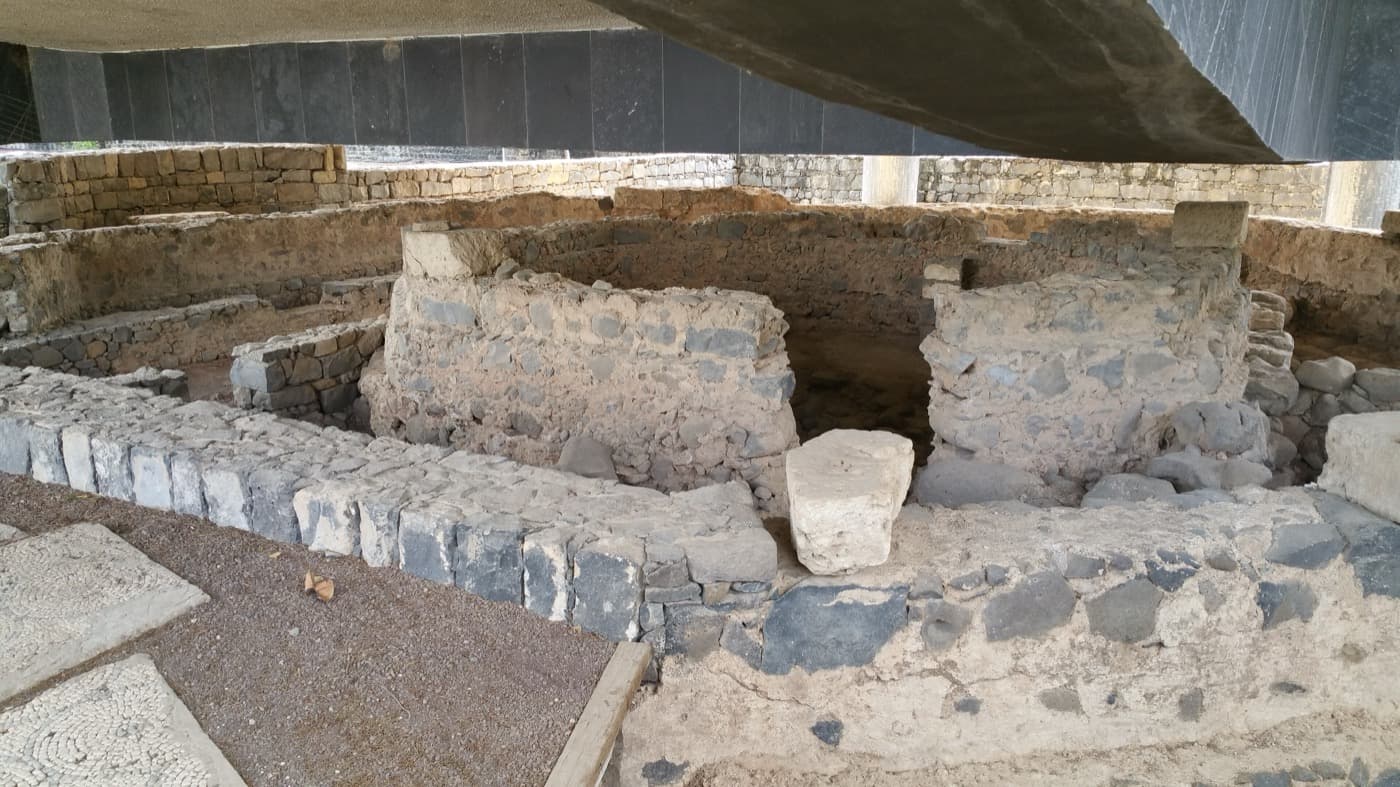
Peter’s house at Capernaum
first century AD, with a church built over it by the 400s · Capernaum, on the Sea of Galilee
The dark basalt walls in the middle are an ordinary fisherman’s house from Jesus’ day. Within a century Christians were scratching prayers to Jesus on its plaster, and by the 400s an eight-sided church stood on top of it, the way pilgrims mark a place they are sure of. The Gospels say Jesus healed Peter’s mother-in-law here.
Found: Excavated between 1968 and 1986 by the Franciscan archaeologists Virgilio Corbo and Stanislao Loffreda, under the ruins of the octagonal church.
If you were inventing a religion, you would not make your leaders cowards or pick first witnesses whose word carried no weight in court. The Gospels do both.
Key point 03
It is not the story people would invent.
If you were writing a religion to benefit yourself, you would make your leaders look good and your message easy. The Bible does the opposite, over and over. Historians call this the : people do not invent details that make them look bad.
The , the future leaders of the church, run away when Jesus is arrested. Peter denies knowing Him three times.
The first witnesses of the empty tomb are women, whose testimony carried little weight in court at the time. If you were inventing it, you would pick men.
Jesus’ own family thought He was out of His mind.
Some of the doubted even after seeing Him risen.
The message itself cuts against self-interest: love your enemies, deny yourself, the last will be first, and no one gets to boast.
Human authors wrote it, but the message keeps contradicting what human authors want. That is one of the clearest signs the message came from God, not from the people who wrote it down.
Jesus in Roman and Jewish records.
Writers who had no interest in promoting Christianity, and some who despised it, still confirm the basic facts: a man called Christ, executed under Pontius Pilate, whose followers worshiped Him as God within a lifetime of His death.
Tacitus, Roman historian
Annals 15.44, about AD 116
Records that “” was executed by Pontius Pilate under Tiberius, and that Nero blamed Christians for the fire of Rome in AD 64.
Josephus, Jewish historian
Antiquities 20.9.1, about AD 93
Mentions the execution of James, “the brother of Jesus, who was called Christ,” without needing to explain who Jesus was. His readers already knew.
Pliny the Younger, Roman governor
Letters 10.96, about AD 112
Reports to the that Christians met before dawn and sang hymns “to Christ as to a god.”
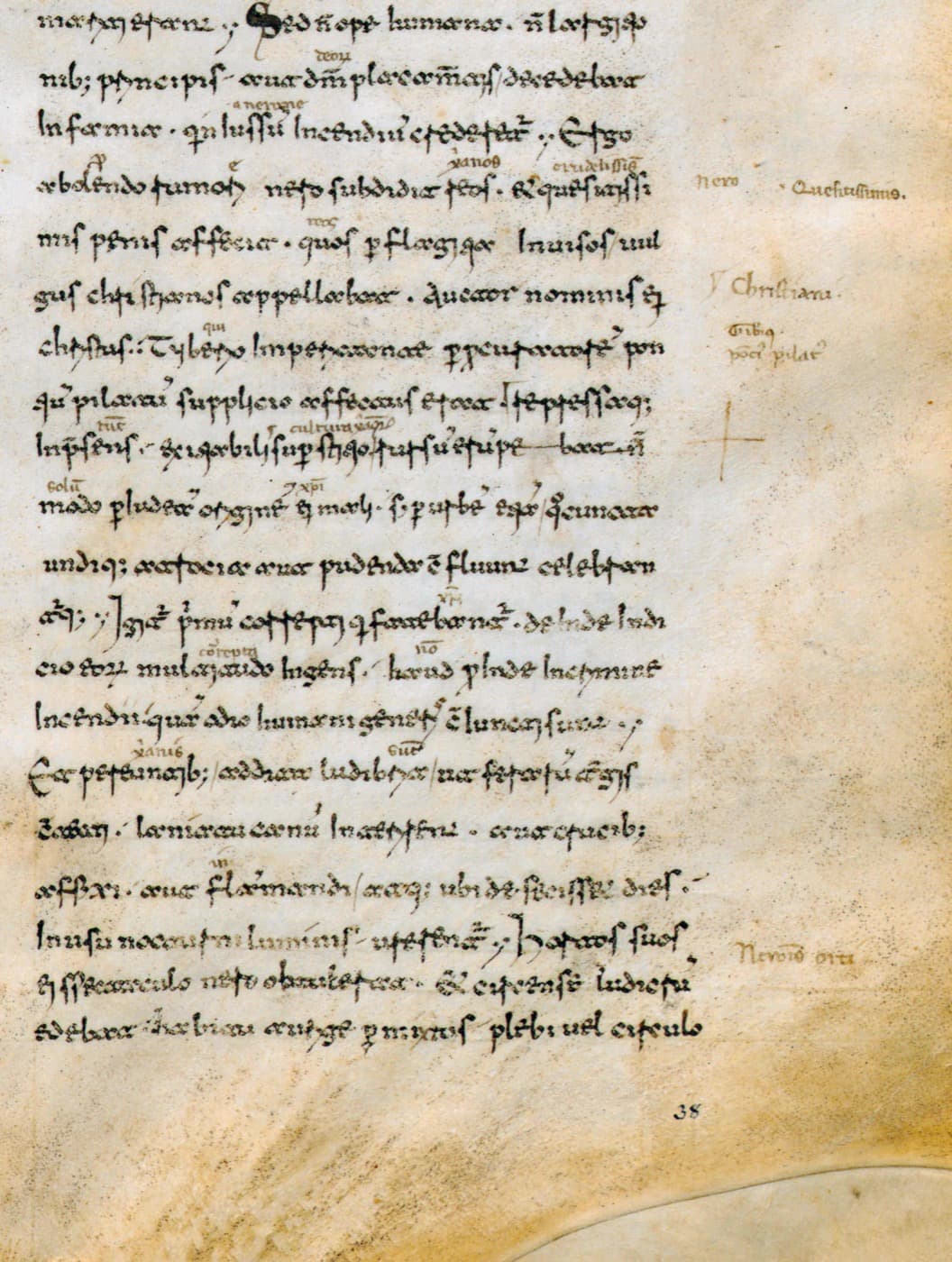
Tacitus, Annals 15.44 — the page that names Christ
copied about AD 1050 (Tacitus wrote about AD 116) · Laurentian Library, Florence (Codex Mediceus 68 II)
The only surviving copy of this part of the . Halfway down: “suffered the extreme penalty” under Pontius Pilate. A later reader wrote “Christiani” and “Pontius Pilatus” in the margin. Every printed edition of this passage descends from this one page, copied more than 900 years after wrote it, and no historian doubts it.
Found: Copied at the of Monte Cassino in the eleventh century and brought to Florence in the 1400s, where it has been ever since.
Josephus, Antiquities of the Jews — a medieval copy
copied in the 1100s (Josephus wrote about AD 93) · Bibliothèque nationale de France, Paris (Latin 8959)
A translation of , the Jewish historian who names James “the brother of Jesus, who was called Christ.” Like Tacitus, Josephus reaches us through copies made a thousand years after he wrote, and historians rely on him without hesitation.
Found: Copied in France in the twelfth century; in the French royal library since before the Revolution, now the national library in Paris.
This is why no serious historian, Christian or not, doubts that Jesus lived and was crucified. The question the evidence forces is not whether He existed. It is what happened next.
04
Skeptics argue about the resurrection. Almost nobody argues about the cross. Here is why even the critics agree He died.
Key point 04
The crucifixion itself is not in doubt.
Before asking whether Jesus rose, it is worth being clear that He really died, in public, on a Roman cross. That is confirmed by writers who were not Christians, accepted by the most skeptical historians alive, and consistent with the medical facts.
Non-Christian sources
Tacitus, Roman historian (about AD 116)
Christus “suffered the extreme penalty” under Pontius Pilate. Annals 15.44.
Josephus, Jewish historian (about AD 93)
Pilate “condemned him to the cross.” 18.3.3. Later Christian copyists added to this passage, but scholars across the spectrum accept the line as original.
Lucian of Samosata, Greek satirist (about AD 165)
Mocks Christians for worshiping “the man who was crucified in Palestine.” The Death of Peregrinus 11.
The Talmud (Sanhedrin 43a)
Records that Yeshu was “hanged on the eve of Passover.” A hostile source, and it still confirms the execution and its timing.
What skeptical scholars say
“That he was crucified is as sure as anything historical can ever be.”
John Dominic Crossan, co-founder of the Jesus Seminar, Jesus: A Revolutionary Biography (1994)
“Jesus’ death as a consequence of crucifixion is indisputable.”
Gerd Lüdemann, atheist New Testament scholar, The Resurrection of Christ (2004)
“The crucifixion of Jesus by the Romans is one of the most secure facts we have about his life.”
Bart Ehrman, agnostic historian, University of North Carolina
The medical evidence
In 1986 the Journal of the American Medical Association published a study of the flogging and described in the . Its conclusion: Jesus was dead before the spear was thrust into His side, and the “blood and water” John reports fits what a spear wound to the chest of a dead man would release. Roman executioners were professionals. The spear was the check. Pilate would not release the body until a centurion confirmed the death.
Why it matters: every alternative to the that starts with “maybe He did not really die” has to get past all of this first.
They believed it enough to die for it. But two thousand years of copying sit between their pen and your Bible. Did the text survive?
Next stop · The evidenceThey believed it. But is the text in your hands what they actually wrote, two thousand years later?↓
The resurrection is the whole point.
Paul said it bluntly: if Christ was not raised, Christianity is worthless and Christians are to be pitied. Everything rests on one event, witnessed by hundreds, preached within weeks in the very city where it happened, and never retracted under torture. If it happened, death is not the end. That is the hope.
1400 BC700 BC125 BCAD 33AD 125 ▾AD 350Today
Egypt · AD 125
04The evidence
Summarized in one sentence
The text we have today matches what was written, with more and earlier copies than any other book from the ancient world.
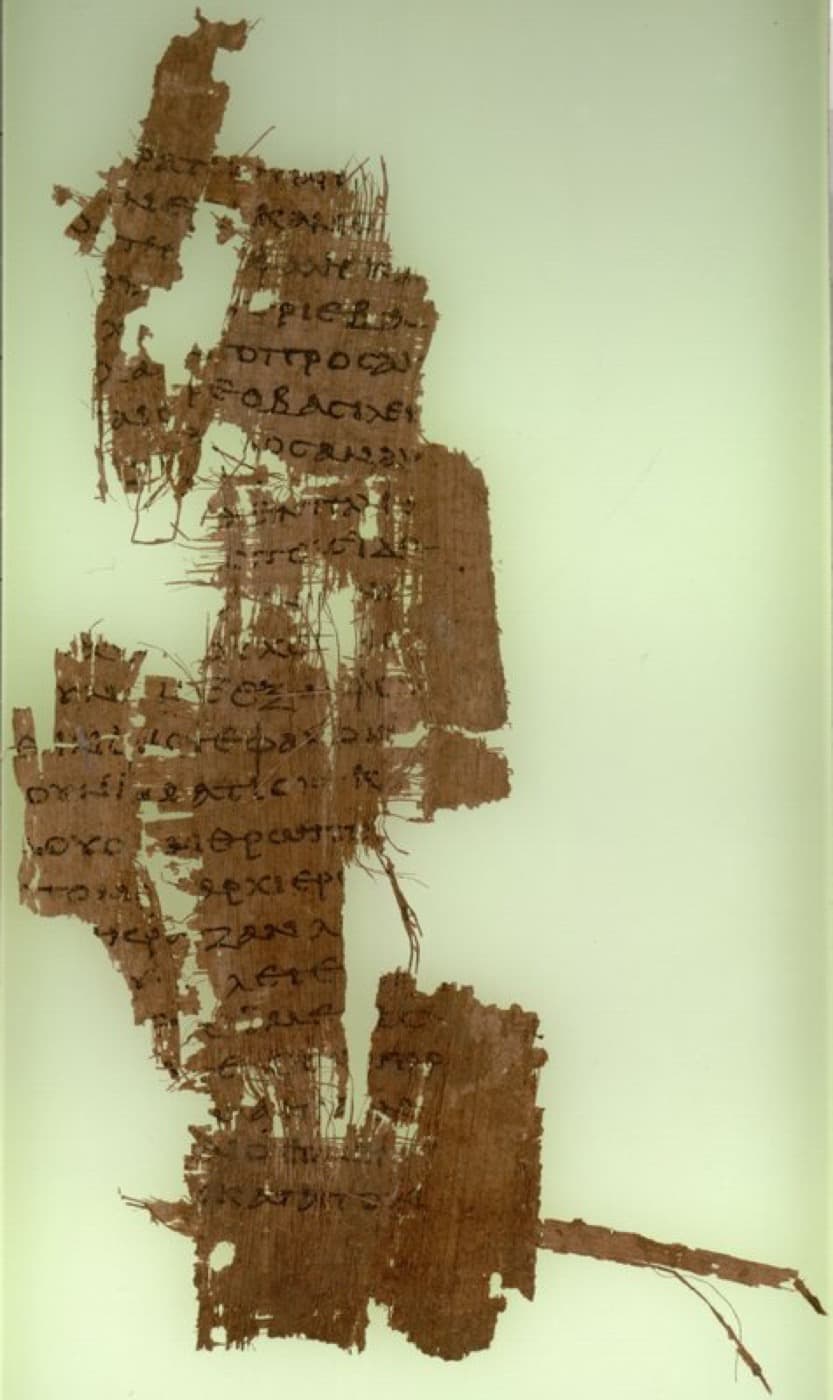
Papyrus 90 · about AD 150–175
John 19, dug from the rubbish heaps of Oxyrhynchus, Egypt, between 1897 and 1906. Sackler Library, Oxford.
04
04The evidence6 min read
By the end of this section you will be able to explain why the New Testament in your hands matches what was written, better than any other book from the ancient world.
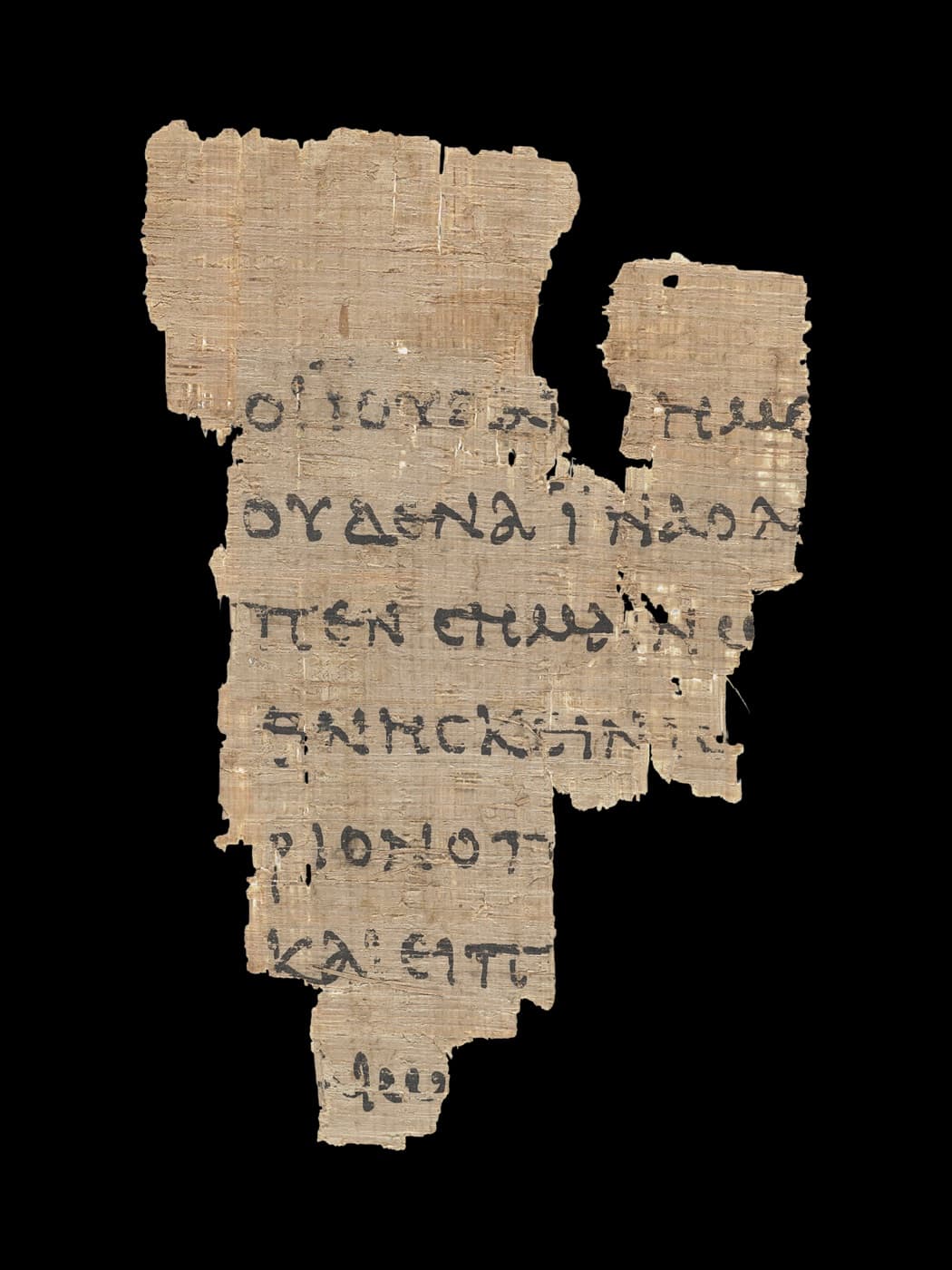
Papyrus P52 — the oldest known piece of the New Testament
about AD 125 (range 100–150) · John Rylands Library, University of Manchester
A credit-card-sized scrap of John 18:31–33, copied within a lifetime of the original. Pilate is asking Jesus, “What is truth?”
Found: Bought in Egypt in 1920 by the papyrologist Bernard Grenfell, probably from the Fayum; its text was identified in 1934 by Colin Roberts in Manchester.
We do not have the original sheets any ancient author wrote on. For every ancient book, what survives is copies. Two things decide how much you can trust the copies: how many there are, and how soon after the original they were made. On both counts the New Testament is in a class by itself.
5,800+
Greek of the New Testament cataloged
about AD 125
date of the oldest fragment, a piece of John held in Manchester, within a lifetime of the original
< 1%
of the differences between copies change the meaning and are still unresolved. None of them affects a Christian belief. Even the best-known skeptical scholar agrees.
Because there are so many copies, every difference between them can be found and compared. Most are spelling and word order. In the handful of places where the copies differ in a way that matters, no Christian belief depends on which reading is right, because every teaching of the faith is also stated clearly in passages where all the copies agree.
Surviving handwritten copies
New Testament5,795
Gap to earliest copy: about 30–50 years to the first fragment; full copies within 300
Homer, Iliad1,757
Gap to earliest copy: about 400 years to substantial copies
Caesar, Gallic Wars251
Gap to earliest copy: about 950 years
Plato, dialogues210
Gap to earliest copy: about 1,200 years
Herodotus, Histories109
Gap to earliest copy: about 1,400 years
Tacitus, Annals2
Gap to earliest copy: about 800 years
Greek manuscripts only. Add roughly 10,000 in Latin and tens of thousands in other early languages, plus quotations in early Christian writers that could rebuild nearly the whole New Testament on their own.
01
Five thousand eight hundred handwritten copies, made over a thousand years by people with no printing press. How closely do they agree?
Key point 01
The copies agree with each other about 99.5 percent of the time.
Put the copies side by side and they say the same thing. Using , the science of comparing copies to recover the original, scholars know about 99.5 percent of the New Testament text for certain, and in the remaining half a percent they know exactly what the options are. The differences are almost all spelling, word order, and a word present in one copy and missing in another. That is not a claim Christians make about their own book. It is what the manuscripts show anyone who reads them.
99.5%
of the original text is known for certain; for the other 0.5 percent every option is on the table (Grand Canyon University; Geisler and Nix)
99.9%
of the text is “free from real concern” by the count of the Greek scholar A. T. Robertson
98.3%
even at the strictest count: in 1881 Westcott and Hort judged that only one difference in sixty rose above trivialities
0
Christian beliefs that rest on a disputed line. The best-known skeptical scholar, Bart Ehrman, says so himself
Why do skeptics talk about “hundreds of thousands of differences”?
Because of how differences are counted. One misspelled word in one copy is one difference, and there are more than 5,800 Greek copies to count across. More copies always means more differences to catalog, the same way a hundred students copying a paragraph produce more typos between them than ten would. Spread across the copies, the average manuscript differs from the others in tiny ways, and the sheer number of copies is exactly what lets scholars see which reading is original.
What the other half a percent looks like
most
Spelling and word order
The large majority. Greek word order is flexible, so “Jesus Christ” and “Christ Jesus” mean the same thing, and names were spelled several ways. These change nothing.
some
A word present or missing
“The Lord Jesus” in one copy, “Jesus” in another. Meaningful in the sense that it is a real difference, but it does not change what the sentence says.
less than 1%
A handful of well-known passages
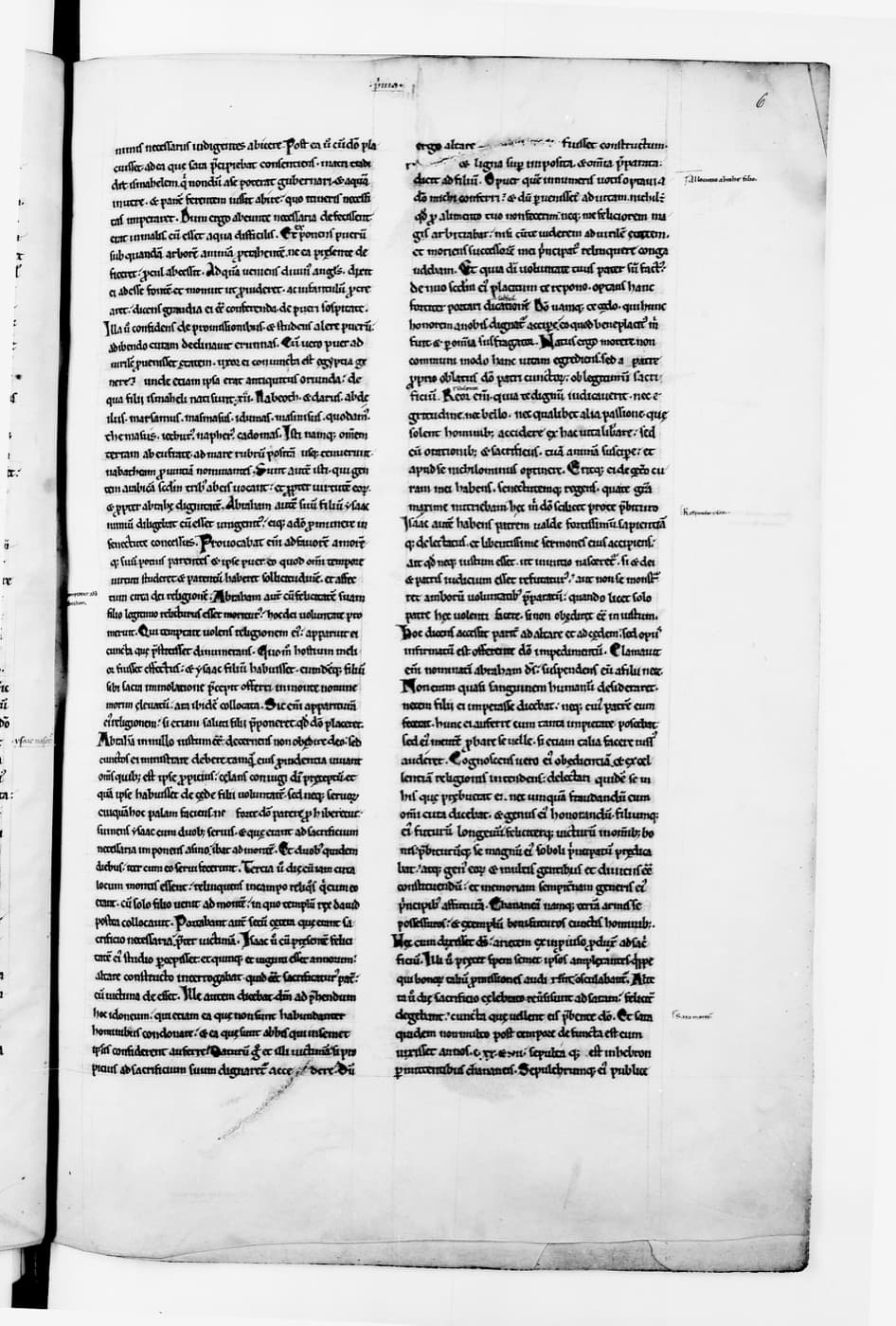
About a dozen places are genuinely uncertain, and every good Bible marks them for you in a footnote or a bracket: the longer ending of Mark (16:9–20), the woman caught in adultery (John 7:53–8:11), and a line in 1 John 5:7 are the famous ones. Nothing Christians believe depends on any of them; every teaching in those passages is also taught elsewhere without dispute.
So when you hold a New Testament, you are not holding a guess about what the apostles wrote. You are holding what they wrote, recovered from more copies, with more agreement, than any other book from the ancient world.
Sources: Grand Canyon University, “Is the Old Testament Trustworthy to the Original?” (2020); Daniel McCoy, “Is the New Testament Reliable?” (Renew.org); Norman Geisler and William Nix, A General Introduction to the Bible (1986), with Geisler’s later note on the figure; Daniel B. Wallace (see source 16); Bart Ehrman, Misquoting Jesus (2007 paperback), p. 252.
02
A thirty-year gap sounds reassuring. A three-hundred-year gap sounds worrying. Here is how scholars close both, and why the gap was never the real question.
Key point 02
The copies can be checked, and they check out.
Nobody has to take it on trust that a copy is right. The text reached us along several independent roads, and each road can be compared with the others. When copies made in different countries, translations made into different languages, and quotations written by different authors all carry the same words, those words are original. When they disagree, the disagreement is out in the open and can be weighed.
01
Copies from different places
By AD 200 the New Testament was being copied in Egypt, Syria, Asia Minor, Greece, Italy, and North Africa by people who never met. A change made in one place shows up as a disagreement with all the others. The clearest test case: Papyrus 75, copied about AD 200, and Codex Vaticanus, copied about AD 350, are 150 years and many generations of copying apart, and their text of Luke and John is nearly identical.
02
Early translations
By about AD 180–300 the New Testament had been translated into , , and . A translation freezes the Greek text it was made from, so each of these is an independent witness to what the Greek said in the second and third centuries, before most surviving Greek copies were made.
03
Quotations by early Christian writers
Christian teachers from about AD 95 onward quoted the New Testament constantly, and shelves of their books survive. Bruce Metzger, the leading textual scholar of the last century, wrote that if every manuscript were lost, those quotations alone would be enough to reconstruct practically the entire New Testament.
04
Every difference is on the table
Because every copy can be compared with every other, scholars have cataloged each difference. That is where the 99.5 percent figure comes from, and the few hundred places that are still uncertain are printed in the footnotes of your Bible. A hidden change is the one kind of change that cannot exist here.
How big is the gap, really?
30 years
Best case. Papyrus 52, a piece of John 18, copied about AD 125.
100–200 years
Typical case. Substantial copies of most New Testament books, about AD 175–250: Papyri 45, 46, 66, and 75.
about 300 years
Worst case for the New Testament. A few short letters, such as 1 Timothy and 3 John, have no surviving copy older than the great fourth-century Bibles, Sinaiticus and Vaticanus.
800–1,000 years
The Old Testament. Its oldest surviving words, the Ketef Hinnom silver scrolls of about 600 BC, come roughly 800 years after Moses on the traditional dating, and substantial copies, the Dead Sea Scrolls, about a thousand. Those scrolls then match the AD 1008 Leningrad Codex across a further thousand years. That is the test, and the text passed it.
Is there a gap too big to trust?
Historians do not use a cutoff. They ask how many copies survive, how independent they are, and how closely they agree, and then they compare book with book. wrote his about AD 116; the only surviving copy of the part that mentions Christ was made around AD 1050, more than 900 years later, and no historian throws it out. Caesar’s : about 950 years to the oldest copy. Plato: about 1,200. Herodotus: about 1,400. All of them are accepted as reliable text. Judged by the same test, the New Testament is the best-attested book of the ancient world by a wide margin. F. F. Bruce, who taught biblical criticism at Manchester, put it plainly: “There is no body of ancient literature in the world which enjoys such a wealth of good textual attestation as the New Testament.”
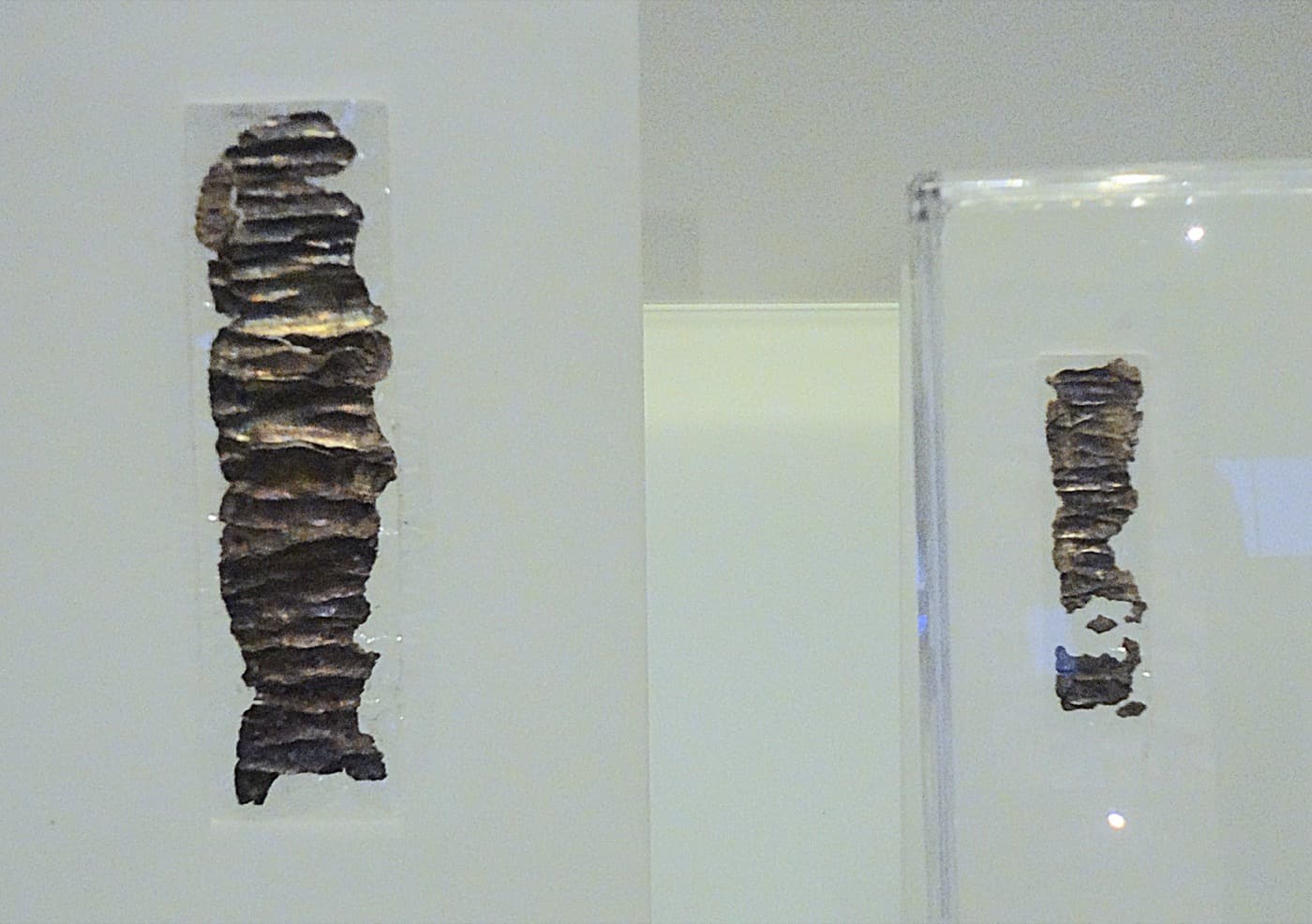
The Ketef Hinnom silver scrolls — the oldest words of the Bible that survive
about 600 BC · Israel Museum, Jerusalem
Two rolled silver , the larger barely four inches long when unrolled, scratched with the priestly blessing of Numbers 6: “The LORD bless you and keep you.” About four centuries older than the Dead Sea Scrolls.
Found: In 1979 by Gabriel Barkay’s excavation in a burial chamber at Ketef Hinnom, just southwest of Jerusalem’s Old City. It took three years to unroll the larger one without breaking it.
A Coptic New Testament — Paul’s letters and John in the language of Egypt
about AD 600 (the Coptic translation itself dates from about AD 250–300) · Chester Beatty Library, Dublin (Cpt 813)
The opening of Romans in Sahidic . A translation freezes the Greek text it was made from, so the early , , and Coptic versions are independent witnesses to what the Greek said in the 200s.
Found: From the library of the Apa Jeremias monastery at Saqqara, south of Cairo; acquired by Alfred Chester Beatty for his collection in Dublin.
Sources: Bruce M. Metzger and Bart D. Ehrman, The Text of the New Testament, 4th ed. (Oxford, 2005), pp. 94–126 on the early versions and p. 126 on the quotations; Kurt and Barbara Aland, The Text of the New Testament, 2nd ed. (Eerdmans, 1989), for the earliest surviving copy of each book; F. F. Bruce, The Books and the Parchments (1950), p. 178; Gabriel Barkay et al., “The Amulets from Ketef Hinnom,” BASOR 334 (2004).
See them yourself
These are not drawings. They are photographs of the actual copies.
Two books from about AD 200, found together in a jar in Egypt in 1952. They were copied within a century of the originals, and the text in them is the text in your Bible.
Papyrus 66 — the Gospel of John, nearly complete
about AD 200 · Bodmer Library (Fondation Martin Bodmer), Cologny, Geneva
Seventy-five leaves of John, still stacked as a book, copied within about a century of the original. The top page is John 1:1, “In the beginning was the Word.”
Found: In 1952 near Dishna in Upper Egypt, part of a jar of books later called the Bodmer Papyri; bought by the Swiss collector Martin Bodmer in 1956.
about AD 175–225 · Vatican Library, Rome (Hanna Papyrus 1)
The earliest copy of Luke that survives in bulk, bound together with John. Its text is almost identical to Codex Vaticanus, copied 150 years later, which shows how carefully the text was passed on. This page is Luke 14:3–14.
Found: In 1952 near Dishna in Upper Egypt with the other Bodmer Papyri; given to the Vatican Library in 2007.
For centuries the oldest Hebrew Bible anyone had was copied a thousand years after the originals. Then a shepherd threw a stone into a cave.
Key point 03
And the Old Testament passed a thousand-year test.
Until 1947, the oldest complete Hebrew Bible was from about AD 1008. Then the were found, with about 220 biblical a thousand years older. The most famous of them, the Great Isaiah Scroll, the only complete Bible book in the collection, was copied around 125 BC and laid next to the medieval text. The two are essentially the same book. The differences are mostly spelling. A thousand years of hand-copying, and the text held. William F. Albright, the leading biblical archaeologist of his day, called the scrolls “the greatest manuscript discovery of modern times,” and scholars have used that phrase ever since.
about 125 BC
Great Isaiah Scroll copied, Dead Sea Scrolls
AD 1008
Leningrad Codex, the oldest complete Hebrew Bible before 1947
~1,100 yrs
between them, and still the same book
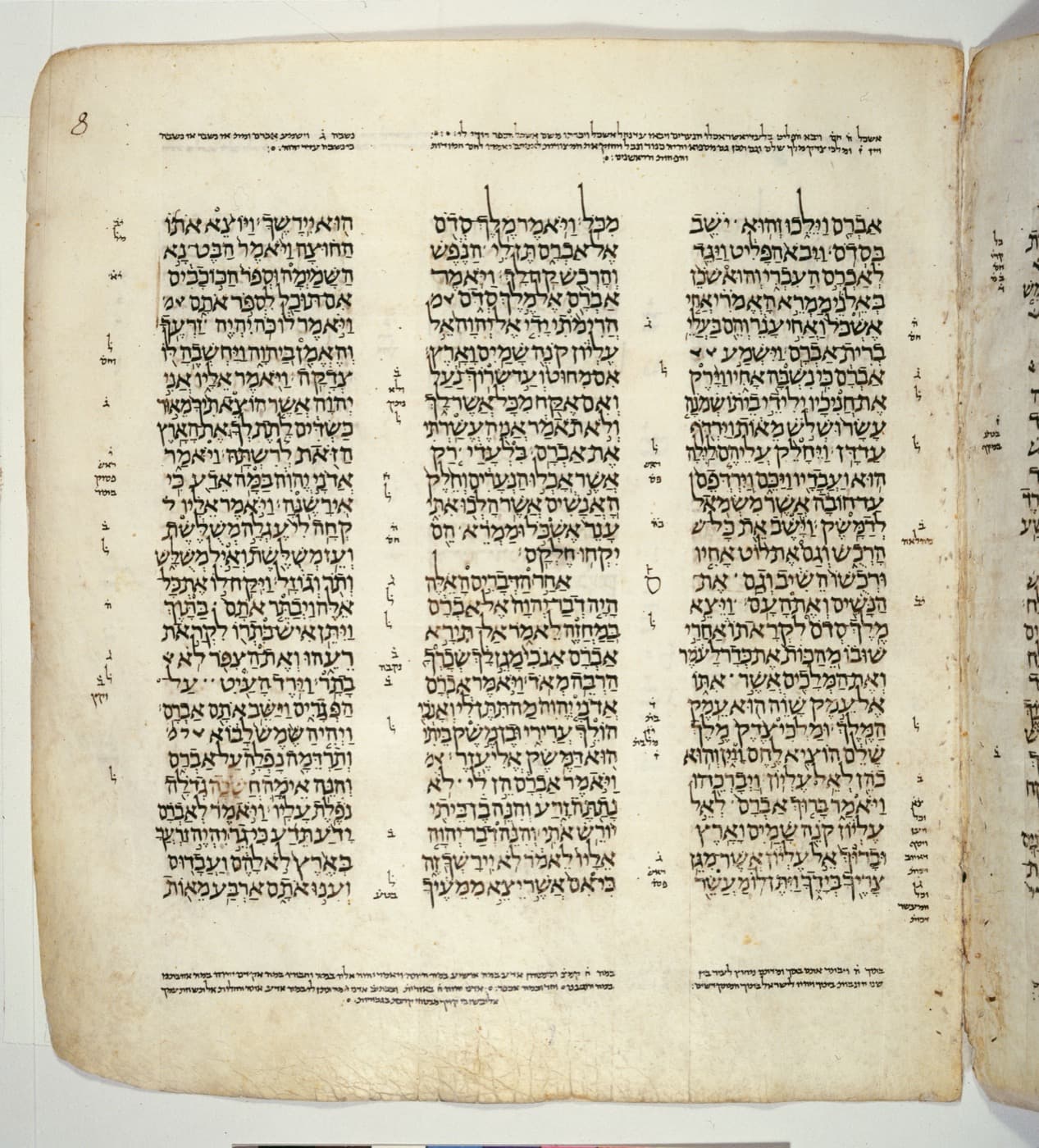
The Leningrad Codex — the oldest complete Hebrew Bible
AD 1008 · National Library of Russia, St Petersburg
A page of Genesis from the manuscript that printed Bibles are still based on today. Before 1947 this was as far back as the complete Hebrew text could be checked.
Found: Copied in Cairo in 1008 by the Samuel ben Jacob; bought by the collector Abraham Firkovich in the 1800s and in St Petersburg since 1863.
Cave 4 at Qumran — where most of the Dead Sea Scrolls were found
scrolls copied about 250 BC to AD 70 · Qumran National Park, near the Dead Sea; the scrolls are in the Israel Museum, Jerusalem
The cave that held about 15,000 fragments of more than 500 scrolls, including copies of every Old Testament book except Esther. The Isaiah scroll came from Cave 1, a short walk north.
Found: Discovered by Bedouin in August 1952, five years after the first scrolls turned up in Cave 1; excavated by archaeologists the same year.
A Dead Sea Scroll from Cave 1 (1Q28a) — out of the same cave as the Isaiah scroll
about 100 BC to AD 1 · Jordan Museum, Amman
One of the seven scrolls the shepherd pulled out of the first cave in 1947. This one is a rule book for the Qumran community rather than a Bible book, but it shows what the finds looked like and why some of them are in Amman: the 1948 border ran between the caves and the museum.
Found: In 1947 in Cave 1 at Qumran with the Great Isaiah Scroll; bought in Bethlehem by the archaeologist Eleazar Sukenik, and later kept by Jordan.
Could these finds be fake? How the specialists check.
Fakes do exist. So how do archaeologists, scientists, and scholars know that a manuscript or an object is really ancient and not a modern forgery? Here are the questions people ask most.
Do we know where it was found?
Yes, for everything on this page. When archaeologists dig something up, they write down exactly where it was, take photographs, and have other people present. That record is kept forever. The Dead Sea Scrolls were taken out of the caves this way. The Pilate stone was found in 1961 by a team of Italian archaeologists digging out an ancient theater. The silver scrolls were found in a tomb during a planned dig. Why does this matter? Because if you know exactly where something came from, you can check its story. A forger cannot fake a dig that dozens of people watched.
How do they know how old it is?
They use two tests, and both have to give the same answer. The first test is done in a laboratory. Leather and papyrus were once living things, and everything that was once alive contains a tiny amount of a natural substance called carbon-14. After death, that substance slowly fades away at a known speed. Scientists measure how much is left, and that tells them roughly when the animal or plant died, and so when the writing material was made. The second test is the handwriting. The way letters are shaped changes over the centuries, a bit like clothing styles. Scholars who study old handwriting compare a manuscript with letters, receipts, and contracts that have dates written on them. If the handwriting matches documents from a certain period, the manuscript is from that period too. The Isaiah scroll got both tests. Both said it was written about 250 to 100 BC.
Couldn’t a forger take old leather and write on it?
People have tried. It does not work, because the ink gives them away. When someone writes on fresh leather, the ink soaks in. When someone writes on leather that is already two thousand years old, the surface is cracked and covered in a thin crust, and the ink sits on top of the cracks and the crust instead of soaking in. A conservator can see this under a microscope. A real case: in 2020, a museum in Washington owned sixteen small pieces it believed were Dead Sea Scrolls. It had bought them from dealers who could not say where they came from. The museum hired conservators and scientists to test them. Every piece was a modern fake, written on old leather. The museum announced the result itself. This is why an object with no record of where it was found is not accepted until it passes tests like these.
What if the words themselves are made up?
A forger would have to write like a person from that time: the same language, the same spelling, the same way of putting sentences together. And the words would have to match the thousands of other copies of the same text that already exist. Getting all of that right at once is nearly impossible, and one mistake gives the forgery away.
Who checks the specialists?
Nobody gets to say “trust me.” When a find is announced, it is described in detail in a scholarly journal, with photographs and test results, so that other archaeologists, historians, and manuscript scholars around the world can examine it. Many of them are rivals or skeptics, and they spend years trying to find a flaw. A find is only treated as real once it has survived that. Everything on this page has.
Aren’t the museums biased?
The Dead Sea Scrolls are kept by the Israel Museum. P52 is kept by a university library in Manchester, England. Codex Sinaiticus is kept by the British Library in London. These are national and university institutions, not churches, and they have no reason to promote Christianity. Historians and scholars who are not Christians accept these finds as genuine too.
So how sure can you be? Everything on this page was found by archaeologists who recorded where it came from, has been tested and examined by specialists, is kept in a museum or university you could visit, and has been open to challenge for decades. Where a date is only approximate, the page says “about.”
Why are there so many Bible translations?
Walk into a bookshop and you will find the ESV, NIV, KJV, NLT, NASB, and more. That is not a sign of confusion. It is what happens when one text is translated, carefully and repeatedly, into a language that keeps changing.
The Bible was not written in English.
The Old Testament was written in (with a little ) and the New Testament in . Every English Bible is a translation of those originals, and the originals are what the thousands of preserve.
English keeps changing.
The King James Version of 1611 was plain English in its day. Four centuries later, words like “thee,” “suffer the children,” and “conversation” no longer mean what they meant. New translations keep the same message readable.
Translators make different trade-offs.
Some stay as close to the original word order as English allows (ESV, NASB). Some prioritize natural, clear English (NIV, NLT). Both are translating the same Hebrew and Greek. The difference is style, not substance.
The original is always there to check.
Because we have so many , anyone can go back to the Hebrew and Greek. Free tools show the original word under each English word. No translation is the final authority; the original text is, and it has not been lost.
The same verse, four translations. Notice the wording changes and the meaning does not. John 3:16
KJV (1611)
“For God so loved the world, that he gave his only begotten Son, that whosoever believeth in him should not perish, but have everlasting life.”
ESV (2001)
“For God so loved the world, that he gave his only Son, that whoever believes in him should not perish but have eternal life.”
NIV (2011)
“For God so loved the world that he gave his one and only Son, that whoever believes in him shall not perish but have eternal life.”
NLT (2015)
“For this is how God loved the world: He gave his one and only Son, so that everyone who believes in him will not perish but have eternal life.”
The message has not changed, because the thing being translated has not changed. God promised that His words would outlast heaven and earth, and the are how that promise looks on a shelf.
The text survived. The witnesses were sincere. Now turn the same questions on whatever you believe today.
Next stop · Ask yourselfNow turn the same questions on whatever you believe today. Fair is fair.↓
1400 BC700 BC125 BCAD 33AD 125AD 350Today ▾
Wherever you are · Today
05Ask yourself
Summarized in one sentence
Ask the same questions of whatever you believe now, including where your sense of right and wrong comes from, and see how it holds up.
05
05Ask yourself4 min read
By the end of this section you will be able to explain how to test any belief, including this one, with six questions.
Ask the same questions of whatever you believe.
Everything above is the Bible facing hard questions. Fairness means asking those same questions of every belief, including the one you hold now. This is not a put-down of anyone. It is the same test, applied evenly.
The Bible praises people who checked
Paul preached in Berea. The listeners went home and checked.
“Now these Jews were more noble than those in Thessalonica; they received the word with all eagerness, examining the Scriptures daily to see if these things were so. Many of them therefore believed.”
Notice the order. They listened eagerly, then they checked every day, then many believed. The writer calls that noble. The Bible does not ask you to switch off your judgment. It asks you to use it.
Paul made the same point on trial before King Agrippa: the events were public and recent, “for this has not been done in a corner.”
Think about it
Most of us inherited our beliefs from family, culture, or the people around us. That is not a reason to keep them or to drop them. It is a reason to check them.
How the Bible answers it
The Bible invites checking. The Bereans were praised for examining the Scriptures daily to see if what Paul said was true (Acts 17:11). “Test everything; hold fast what is good” (1 Thessalonians 5:21).
If the evidence holds, the question stops being academic. What was it all for?
Next stop · The giftIf all of this is true, what does it ask of you? Less than you think, and more.↓
1400 BC700 BC125 BCAD 33 ▾AD 125AD 350Today
Golgotha, outside Jerusalem · AD 33
06The gift
Summarized in one sentence
Because God is both just and loving, Jesus paid for sin Himself, so salvation is a gift you receive, not a wage you earn.
06
06The gift8 min read
By the end of this section you will be able to explain why Jesus had to die, what “done” means, and what to do if you believe it.
“For by grace you have been saved through faith. And this is not your own doing; it is the gift of God, not a result of works, so that no one may boast.”
Why did Jesus have to die?
People often ask why God did not simply forgive everyone and skip the cross. The answer is in who God is. The Bible describes His character in a handful of words, and two of them, just and loving, explain the cross.
God is love
God does not merely have love. He is love, and it is the reason He acts at all.
God is holy
Completely pure, set apart from all wrong. Sin cannot stand in His presence.
God is just
He always does what is right and will not call guilt innocent. A judge who lets crime slide is not good. He is corrupt.
God is merciful
Slow to anger, overflowing in kindness, glad to forgive. The same verse that calls Him just calls Him merciful.
God is unchanging
He does not shift with moods or centuries. What He was, He is.
God is faithful
He keeps every promise, even when we do not keep ours.
God is truthful
He cannot lie. What He says about us, and about Himself, is simply true.
Merciful and just, at the same time
Exodus 34:6–7 says both in one breath. God cannot switch off one to make room for the other. The cross is the only place where both are fully satisfied.
01
Because He is just, sin has a real cost.
God cannot pretend our wrong never happened. That would make Him unjust, and He is not. The Bible’s word for the cost is death: separation from the source of life.
02
Because He is love, He did not want us to pay it.
He takes no pleasure in anyone being lost. He wants everyone to turn and live.
03
So at the cross, justice and mercy meet.
The penalty was paid in full, by God Himself, in Jesus. That is how He can be both just and the one who forgives. The innocent took the place of the guilty.
And He did it willingly.
Jesus was not a victim of circumstances. He said no one took His life from Him; He laid it down on purpose. He told Peter He could call twelve legions of angels and chose not to. The night before, He asked if there was another way, and then went anyway.
01
For fifteen hundred years Israel sacrificed lambs that could never actually fix anything. Then John the Baptist pointed at a man and said, “Look, the .”
Key point 01
The perfect sacrifice, promised for centuries.
The cross did not come out of nowhere. From the first pages of the Bible, sin cost a life, and God had been pointing to Jesus the whole time.
01
Sin has always required blood.
When the first people sinned, God covered them with animal skins: the first death in the Bible was for someone else’s wrong. Later He gave Israel a whole system of . The rule underneath it was simple: life is in the blood, and without blood there is no forgiveness. Because God is just, sin is never simply waved away.
the lamb, without blemish
02
The animal sacrifices were a placeholder.
They had to be repeated every day and every year, which tells you they never finished the job. The Bible says so itself: the blood of bulls and goats cannot take away sins. They were a , a picture pointing ahead to a greater sacrifice still to come.
“like a lamb led to the slaughter”
“God will provide the lamb”
03
Jesus was the real thing.
A sacrifice for sin had to be spotless. Jesus is the only person who ever lived without sin, which is why John the Baptist called Him the Lamb of God and why His one death could do what a million animals could not. Once, for all, finished.
God knew we could never meet His standard or fix this ourselves. So, in His love, He did not lower the standard. He met it for us, and gave us His Son.
The most hated object in the Roman world.
The Romans made one of the cruelest execution methods in history. It was reserved for slaves and rebels, and the Roman statesman Cicero called it “the most cruel and disgusting punishment,” one whose very name should be kept far from a Roman citizen’s ears. Under Jewish law, a man hung on a tree was under God’s curse. The cross was designed to be the ultimate humiliation. God took that exact object and made it the instrument of rescue. What people meant for evil, He meant for good.
hung on a tree: cursed
Christ became a curse for us
the cross: foolishness to the world, the power of God
He triumphed over them in it
crucified by lawless men, according to God’s definite plan
you meant evil; God meant it for good
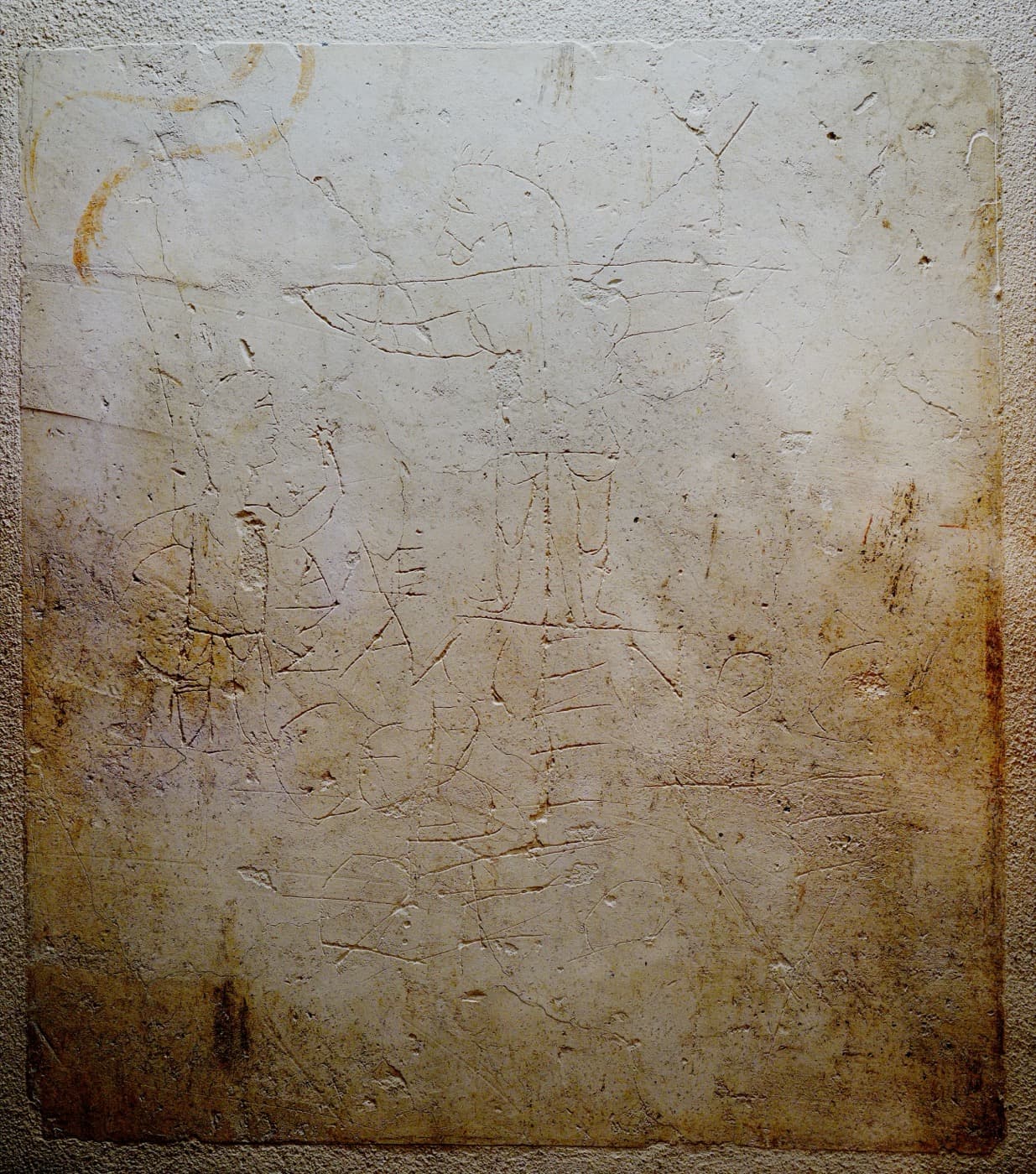
The Alexamenos graffito — the earliest picture of the crucifixion, and it is a joke
about AD 200 · Palatine Museum, Rome
Scratched into a wall to mock a Christian: a man raising his hand to a crucified figure with a donkey’s head, and the words “Alexamenos worships his god.” This is how the Roman world saw the cross, and Christians preached it anyway.
Found: In 1857 when a building on the Palatine Hill in Rome, probably a training school for imperial slaves, was excavated.
Every religion on earth hands you a list. One hands you a receipt marked paid in full. That difference is the whole message.
Key point 02
Every other religion says do. Jesus says done.
Here is what sets Christianity apart from every other belief system on earth. Every other religion tells you to earn your way to God: keep the rules, do the rituals, tip the scales, and hope it is enough. Christianity says you cannot earn it. So God did the work Himself, in Jesus, and offers the result as a gift. You do not pay for a gift. You receive it.
A message like this is not one people would invent. Invented religions flatter the people who invent them. This one says nobody may boast. That is one more reason to believe it came from God and not from us.
The problem is real. Every one of us falls short, and no amount of effort closes the gap.
God did not wait for us to improve. While we were still against Him, Christ died for us.
The last thing Jesus said on the cross was “It is finished.” Paid in full.
Wages are earned. Gifts are given. Eternal life is a gift.
Saved not because of works done by us in , but according to His own mercy.
Jesus is the only way.
This is the claim people find hardest, and Jesus made it Himself. He did not say He was one path among many. He said He was the way, the truth, and the life, and that no one comes to the Father except through Him. If the rest of this page is true, that is not arrogance. It is the only person who paid the price telling you where the door is.
Trust Him, and He changes you.
Salvation is a gift, not a wage. But a gift like this does not leave you as you were. Put your trust in Jesus and He gives you a new heart and His own Spirit, and over time your character, the way you think, love, and treat people, becomes more like His. Not your appearance: your heart. Good character grows the way fruit grows on a healthy tree: not forced, but natural. That is why the verse right after Ephesians 2:8–9 says we were created for good works. The works do not earn the gift. They are what the gift produces.
A new creation. The old has passed away.
A new heart and a new spirit, promised centuries in advance.
The fruit of the Spirit: love, joy, peace, patience, kindness, goodness, faithfulness, gentleness, self-control.
Stay connected to Him and you bear fruit. Apart from Him, nothing.
Being shaped, inwardly, to be like Jesus, step by step.
He finishes what He starts.
Created for good works, right after “not a result of works.”
A tree is known by its fruit.
What now?
This is for people who genuinely want to know what is true. If you have already decided not to believe no matter what is shown to you, no amount of evidence will change that, and Jesus said as much. But if you are honestly seeking, God has made a promise: seek Him with your whole heart and you will find Him. You do not have to decide everything today. You can take one honest step.
01
Read John
One chapter a day for three weeks. It was written “so that you may believe” (John 20:31). Read it as an adult reading a witness, not a child reading a fairy tale.
02
Talk to God
Out loud, alone, honestly. “If you are real, show me.” He says that anyone who seeks Him with their whole heart will find Him (Jeremiah 29:13; Matthew 7:7).
03
Ask someone
Find a Christian you respect and bring them your honest questions, not to win an argument but because you want the answer. Or find a church that teaches the Bible plainly and sit in the back for a month.